Recently, on a trip around Europe, I visited the Dachau Concentration Camp Memorial Site. Dachau was the first (and longest operating) concentration camp opened by the Nazi regime, beginning operation shortly after Hitler took power in 1933. We’d all like think that, as a species we would have moved on from such depravity, that we have learnt the lessons of Dachau and camps like it — that such atrocities would never happen again. Yet, despite the endless cries of never again, these things keep happening time and time again — from the “re-education” camps in Xinjiang to the genocide in Gaza. Ultimately, we remain haunted by the ghosts of Dachau, the same fascistic and authoritarian impulses that enabled this depravity, continue to linger among us. When will we learn the lessons of Dachau? When will we do right, by those who perished at Dachau, at Austerlitz, at Buchenwald…?
Establishment of the Camps
Dachau is a town northeast of Munich, the birthplace of the Nazi movement. In 1933, a concentration camp was opened in Dachau, on the grounds of a former gunpowder and munitions factory on 22 March, almost immediately after the Nazis seized power in Bavaria on 9 March. Four large police trucks transported approximately 200 prisoners from Stadelheim prison in Munich and the Landsberg fortress, forming the first prisoners of the new concentration camp (Marcuse, 2001). The camp at its establishment, did not immediately fill with the stench of blood, torture and death that we associate with it today. As historian Nikolaus Wachsmann writes in KL: A History of the Nazi Concentration Camps on the conditions on the opening day (Wachsmann, 2016),
Wachsmann, KL: A History of Nazi Concentration Camps
… there are no more than 100 or 120 political prisoners, largely local Communists from Munich. … it seemed bearable: the guards were not Nazi paramilitaries but amiable policemen, who chatted with the prisoners, handed out cigarettes, and even slept in the same building. The next day, the prisoner Erwin Kahn wrote a long letter to his wife to say that all was well in Dachau. The food was good, as was the treatment, though he was getting restless waiting for his release. “I am just curious how long this whole business will last.”
However, grim days lay ahead for the prisoners. In early April, Himmler replaced the state police guards in Dachau with his own SS men. By May, 12 men had been tortured to death or outright murdered.
From the beginning, the Nazis sought to paint Dachau as a “clean” concentration camp. They were re-education camps, the official narrative went, designed as orderly and efficient institutions where “asocial” persons could be isolated from society and “educated” to once again become productive members of German society. One of the earliest articles on Dachau said “members of the Volk who fell victim to foreign seducers … are being educated to become useful members of the National Socialist state by the healing effects of productive work and tight discipline” 1.
This rhetoric brings to mind China’s “re-education” camps for the Uyghurs of the Xinjiang region, the largest-scale arbitrary detention of any ethnic or religious minority since the end of the Nazi regime (Smith Finley, 2020). Uyghurs in Xinjiang are detained without warning, often being taken from their homes under the cover of night — echoing the mass arrests of communists in Nazi Germany after the Reichstag fire. The official narrative invokes the orientalist notion of Muslims as backward and ultra-conservative religious extremists, requiring civilising by the Han Chinese state. Those arrested are labelled as terrorists, extremists and separatists, influenced by ISIS and the Taliban. Held in concentration camps, euphemistically known as “vocation training centres”, they are stripped of their rich culture, language and religion, forced to assimilate to the culture of the dominant Han. Officially however, mirroring the rhetoric of the Nazis, they are merely being given vocational training, to lift them out of poverty and turn them into productive members of Chinese society once released — propaganda that I have heard echoed even by friends and family.
It is important to understand that Dachau and the other early concentration camps constructed by the Nazis were not created ex nihilo. It is often too easy to brush off Nazi atrocities as the a product of uniquely monstrous individuals, obscuring the role of prior institutions in shaping policy. The camps were constructed bit by bit, based on existing traditions and practices, rather than created with a snap of Hitler’s fingers. There exist “some threads, however frayed, [that] tie even the most radical innovations to the past” (Caplan, 2005). The powers of detention authorised by the Reichstag Fire Decree had precedence in Article 48 of Weimar constuition 2 — and the justification of protecting the public from subversive communists would hardly be foreign. Disciplinary methods which were subsequently employed by the SS in the camps were also borrowed “from the prison, the army, and other institutions, as a matter of convenience and opportunism” (Wachsmann, 2016b). Nazi officials, many having spent time behind bars themselves, lifted many elements of the early camps straight from Weimar-era prisons, such as their rigid schedules and the progressive stages system 3.
The continuity of these institutions played a role in how Germans came to accept the newly built concentration-camps. As Caplan writes (Caplan, 2005),
Caplan, Political Detention and the Origin of the Concentration Camps in Nazi Germany, 1933-1935/6
[E]xisting practices of extra-judicial detention and involuntary labour, together with emergency responses to the social crisis of the Depression, provided ostensible precedents and institutional locations that disguised the brutal and ruthless character of Nazi repression, and eased its official and popular acceptance.
In a similar manner, the genocide in Xinjiang, particularly the forced sterilisation of the Uyghurs to control their birth rate, is nothing new to the Han Chinese population. From 1979 to 2015, millions of Han women were subjected to the famous “One-Child Policy” with forced abortions, mandatory IUD insertions and forced sterilisations lying in wait for anyone who did not comply. In constrast, ethnic minorities such as the Uyghurs were regularly allowed to have 2 - 3 children. This historic trauma, borne by the Han majority for the supposed greater good of the nation, has stirred resentment towards ethnic minorities (Ruser & Leibold, 2021). Hence, in 2017, when China began cracking down on the Uyghurs, the genocidal birth control measures where painted as finally giving equal treatment to ethnic minorities through a unified family placing policy. It is even framed as emancipating the backward Muslim Uyghur women by eliminating their antiquated and conservative beliefs 4 (Cui, 2021). An article from a state media outlet writes,
In the process of eradicating extremism, the minds of Uygur women were emancipated and gender equality and reproductive health were promoted, making them no long baby-making machines. Women have since been striving to become healthy, confident and independent.
Such rhetoric cloaks the brutality of the genocide in the language of equality and liberation, while reminding the dominant Han of the historic injustices that were inflicted upon them (Tiezzi, 2021) — hence, stifling their empathy and giving them the moral permission to turn a blind eye to genocide.
Forced Labour
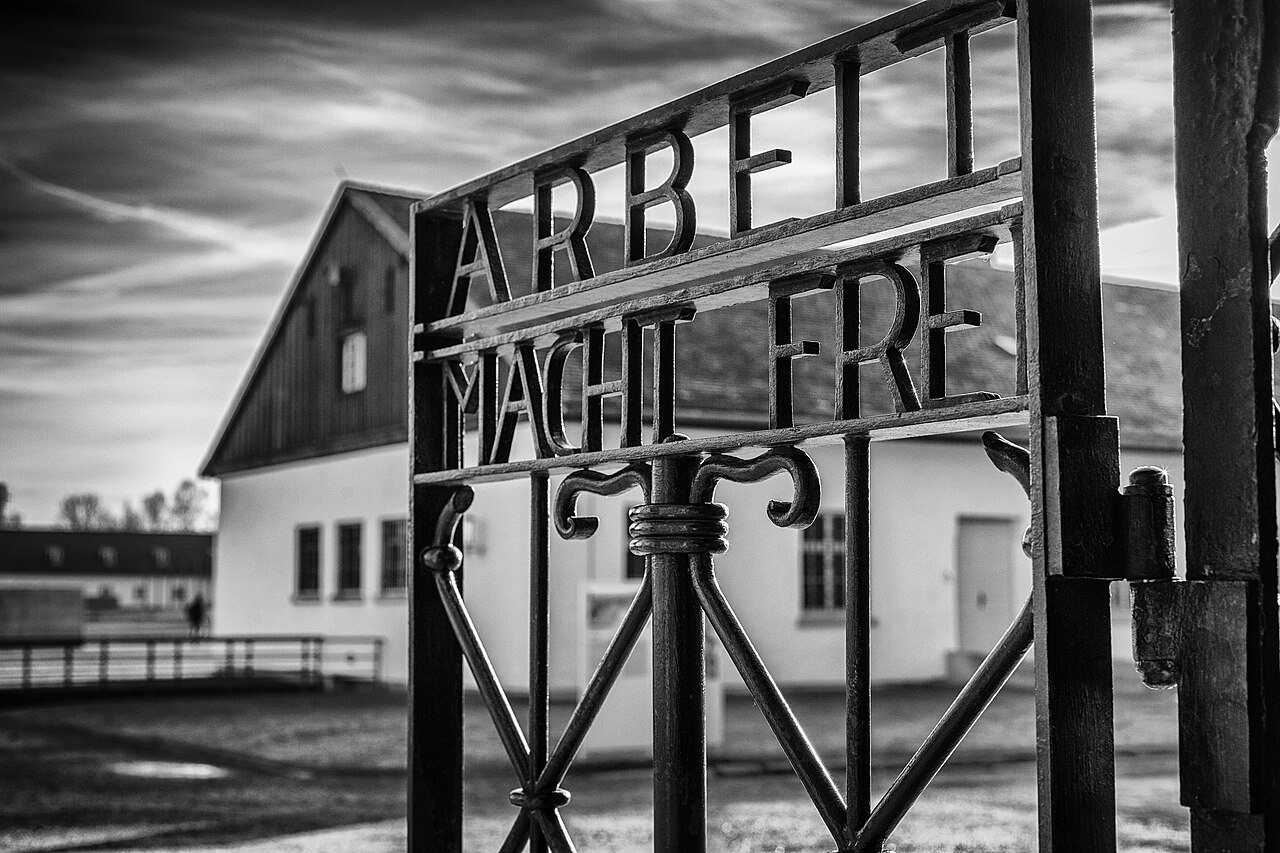
A common misconception about the Nazi concentration camps is that they were death camps, whose explicit goal was the extermination of the Jews via whatever means necessary. While there indeed were such camps, with the most well-known being Auschwitz, many concentration camps instead killed their prisoners slowly, forcing them to slave away in service to the German war machine — and raking in millions of dollars of profits for German industrialists in the process.
Soon after the opening of Dachau, forced labour, whether productive or meaningless, was prescribed as a tool for reeducation 5 as highlighted by the slogan inscribed on the gates Arbeit Macht Frei. Under Nazi ideology, the “People’s Community” (Volksgemeinschaft) only included able-bodied white-Aryan Germans who were willing to conform. Any social deviants, termed “asocials”, were rounded up and forced to perform pointless and often backbreaking tasks 6 or in the case of the T4 Euthanasia program, outright murdered. As Caplan writes (Caplan, 2005),
Caplan, Political Detention and the Origin of the Concentration Camps in Nazi Germany, 1933-1935/6
Nazi pronouncements trumpeted work as the ostensible means of reconciliation and redemption; and the harder the case for redemption, the harder the burden of labour. In the mendacious language of Nazi rhetoric, labour service and the concentration camp joined the prison and the workhouse as mirror-image sites where different groups of people would literally work out their different relationships to the community.
Though the initial prisoners were primarily communists and socialists, in line with the Nazis’ efforts to break the power of the organised German working class, soon many homeless, beggars and welfare recipents, termed “work-shy”, were also being rounded up. The largest of these raids occured in 1938 under Aktion Arbeitsscheu Reich, where some 9,500 “asocial” men were arrested during mass raids in June 1938 and dragged to concentration camps. Among them were paupers such as the forty-six year old Wilhelm Müller who was already being “forced [by the welfare authorities] … to perform menial labor, four days a week, in return for a paltry 10.40 Reichsmark, barely enough to get by” (Wachsmann, 2016c). When he was caught asking for money in the streets, the police labelled him as “asocial” and took him to Sachsenhausen.
This notion that the working poor are nothing more than lazy parasites who refuse to contribute to society and need to be discplined is a fundamental tenet of capitalist ideology. Under laissez-faire capitalism, a person’s worth is tied to their economic productivity. Society is divided into productive individuals and the idle working class. While capitalists must be unobstructed by laws to exploit the labour of the working class, the working class is kept on a leash by market forces to ensure they “contribute” to society, rather than leeching off welfare. Taken to an extreme, such dehumanising views have led to calls from right-wing commentators to euthanise the homeless. The fascist understanding of work, is thus, a mere extension of the capitalist one, where the invisible hand is supplemented with an iron fist, to compel the “work-shy” to labour.
As the war began, slave labour in concentration camps was increasingly used to produce equipment and materials for the war effort. Prisoners of war — Poles, Czechs, Frenchmen, Belgians — were all sent to the concentrations camps, helping to supplement the labour force. New concentration camps from 1938 - 1940 were established near quarries where prisoners were sent to work without any technical equipment, effectively exterminating them through hard labour. As Wagner writes (Wagner, 2010),
Jens-Christian Wagner, Work and Extermination in the Concentration Camps
The combination of over-crowding and the belief of the SS that the camp workforce was expendable (or even superfluous) meant that every new intake of prisoners brought with it a dramatic rise in the death rates. … In the course of 1940, more than a third of all prisoners of Mauthausen and its satellite camp Gusen died.
The sprawling network of 140 subcamps that Dachau is known for, were mostly setup in the latter half of the war after the tides turned against the Germans in Operation Barbarossa. About half of these camps were situated near existing arnament factories, where the prisoners would be deployed to produce material for the war effort. The remainder were construction projects, particularly for underground ammunition facilities that would not be suspectible to bombing raids by the allies. The prisoners would stay in the satellite camps and be rented out to the factories for a fee, which the prisoners of course, never saw a penny of.
To the SS and the factories renting the prisoners, they were fundamentally expendable, nothing more than cogs to be shoved into the teetering German war machine. Due to malnourishment, the productivity of the prisoners was considerably lower than that of civilian workers, causing the factories extend the work-day for prisoners to 12 hours or even longer — which had fatal consequences. They were more careful to keep those working in armament factories alive, as those jobs required expertise that could only be gained after a period of forced labour. In constrast, those working in construction were considered replaceable and were often worked to death.
In fact, prisoners were cycled in horrifying fashion, starting out their “career” in the factories if they had the appropriate skills. As months of toiling in factories wore them out and their health declined, they would eventually be sent to the construction sub-camps where every ounce of labour was beaten out of their bodies. Finally, too weak to work at all, they were sent back to the main camp and perhaps onward to a second camp to be exterminated.
Such a close collaboration between Capital and the Nazis, is further evidence against the idea that fascism is an aberrant totalitarian exception, complete alien to us. The economics of Nazi Germany was fundamentally capitalist. Pretending otherwise will blind us to the many warning indications in our liberal capitalist societies that may lead us down this dark and bloodly path.
The Reckoning
Most people do not realise this legacy of forced labour runs through till today. Many modern-day German companies are guilty of requesting slave labour from the SS, including but not limited to, IG Farben, BMW, Siemens and Volkswagen. The fortunes of the industrial families that running them are stained with blood. Yet, many people remain unaware of this history.
Following the war, most of the major German industralists got off a simple slap on the wrist, with the notable exception of Friedrich Flick. He was charged with crimes against humanity for the usage of forced labour during the war, though even he got light with only 7-years of imprisonment — and after he was released, his investments made him the richest man in Germany (Jong, 2022).
To achieve this, they sought to conceal their ties to the Nazi regime, painting themselves as victims of the Nazi oppression, rather than willing collabrators. For instance, Flick portrayed himself to American interrogators as being coerced into working with the Nazis. He lied about how the Jewish businesses that he had expropiated were in fact, mutually agreed upon deals to enable them to escape the Nazis (Jong, 2022b). Furthermore, all blame supposedly lay with his managers, not himself, because all responsibility for decision-making, including the usage of slave labour, rested solely in their hands?
Or take the example of the founder of BMW, Günther Quandt, who got his brother’s ex-wife Ello to write an affidavit, exonerating him of any blame for his actions (Jong, 2022c).
David de Jong, Nazi Billionaires: The Dark History of some of Germany's Wealthiest Dynasties
“Goebbels took every opportunity to belittle and make fun of the ‘hated Quandt,’” [Ello] declared in an affidavit of late August 1946. She spun a familiar tale about the two men’s relationship: Günther was forced to submit to Goebbels’s demands to join the Nazi Party out of fear that the propaganda master would seize guardianship of young Harald, “eliminate the influence of his father,” and indoctrinate the boy with Nazi ideas. Yet even after Goebbels had successfully claimed Günther’s son, Ello declared that Harald never succumbed to Nazi ideology and that “the love and affection for his father” persisted against all odds.
These declarations became known as Persilschein, after a famous German detergent, as they helped to wash the stain of Nazi collabration away. Friends, family, colleagues, could all provide a statement before a court to refute a suspected Nazi’s alleged crimes. The most valuable of these came from Jews. Günther obtained one from a former Jewish arms executive who worked for him and for whom he secured funds to enable him to flee the Nazis. To further whitewash his image, he wrote a memoir, painting himself as a victim of the Nazis and convieniently glossing over the tens of thousands of forced labourers at his plants during the war.
It is important to note that cries of coercion by the SS to use forced labour are patently false. The blame falls squarely on the shoulders of these wealthy tycoons and their managers. As Wagner writes (Wagner, 2010),
Jens-Christian Wagner, Work and Extermination in the Concentration Camps
The initiative to deploy prisoners in firms almost always came from the enterprises themselves. There is therefore no question whatsoever of forced labourers being imposed upon companies by the SS. This is also illustrated by the fact that, as the war progressed, it was the Ministry of Armaments, not the WVHA 7, which developed into the central directive authority for forced prisoner labour. From October 1944, businesses had to submit their applications for the allocation of concentration camp labour to the Ministry of Armaments and no longer to the SS. The ministry, after assessment, passed the requests on to the SS.
Nevertheless, in part due to these efforts, Günther was not indicted at the trials against industralists at Nuremberg, which were also more limited in scale than the original Nuremberg trials as the Americans did not want the Soviets to turn it into an anti-capitalist show trial in light of the incoming Cold War. Instead, he was sent to a German denazification court which were far more lenient. Unsurprisingly, most Germans were not thrilled to judge their own compatriots for crimes that they themselves had likely participated in — which led to a failure to properly prosecute the crimes of those who participated in the Nazi system.
However, at these trials, Günther still faced Julius Herf, a “prominent public plaintiff [who] … had prosecuted members of the SA in Berlin before 1933 and was now in charge of Bavaria’s most high-profile denazification cases”. Herf, pulled in a key witness, Léon Laval, who Günther had pressured into selling all his shares in a battery-company while he lay in the custody of the Gestapo. Unfortunately, Herf’s prosecution was unsuccessful and the court eventually ruled that Günther was a mere follower of the Nazis, with no other penalty other than paying for his trial fees (Jong, 2022d). Things would go even worse for Herf as he continued with his prosecution of the industralists, with an unknown visitor appearing at his office just before Baron August von Finck’s trial and insinuating that he had damning evidence of Herf’s homosexuality. Under pressure, Herf gave into the blackmail and went easy on von Finck — and eventually, was suspended as a public prosecutor when flirty letters he had written to younger men leaked (Jong, 2022e).
So ultimately, through a combination of changing political circumstances, luck, subterfuge and just being shameless liars, Germany’s industrialists who profited heavily from the war got away with everything, keeping virtually all their assets. As Herf said of Günther and the lack of any sort of guilt from the industrialists (Jong, 2022d),
Julius Herf, prosecutor in Günther Quandt's denazification trial
It’s the intoxication of the pursuit of power, the intoxication of building a huge corporation, the obsession with self-affirmation that is at the root of all this, and it’s the belief in the value of one’s own work, not only because work is something moral, but because building the corporation is the ultimate good, and because anything that resists building it out is bad.
Reparations towards these labourers which constituted 25% of the German economy from 1933 - 1945 were also lacking. The 1953 Federal Compensation Act (and the 1956 law that superceded it) did not compensate those living abroad and those who were not persecuted for racial, religious or political reasons (EVZ Foundation, n.d.). However, no amount of monetary compensation can ever undo the damage done by years of hard labour, both to physical health and in time lost.
Today, some semblance of accountability has been reached, though still severely lacking. When the Berlin wall fell, public pressure forced many German businesses to confront their brutal past of using slave labour. As the world globalised, continued ignorance of their past hurt sales and stock prices, leading some firms to grant permission to historians to enter their archives to research their role in the Nazi regime or even commissioning studies themselves (Jong, 2022f).
In August 2000, the German government and German companies created the Remembrance, Responsibility, and the Future (EVZ) foundation in Berlin, following an agreement between the US and Germany. The survivors of forced labour in the concentration camps would receive compensation payments if no more legal cases would be brought against German firms before American courts. While this provided a semblance of justice for the survivors, it allowed companies to neatly evade legal liability while appearing to take responsibility for their actions (Jong, 2022g).
David de Jong, Nazi Billionaires: The Dark History of some of Germany's Wealthiest Dynasties
As one historian put it: “In this way, the German government and German industry together developed a rhetoric of responsibility with, yet again, no explicit or individual admission of legal liability … the German government occupied the moral high ground, while significant perpetrators conveniently disappeared behind a veil of apparent responsibility without actual guilt.”
Many descendents of the industralists who exploited slave labour also remained adamant about their parents or grandparents innocence. For instance, Sven Quandt “smilingly rejected any moral responsibility for his inherited fortune and minimized his father’s and grandfather’s involvement in the crimes of the Third Reich”, even asking Germany forget and move on from its Nazi past. Only the public outcry forced the Quandts to engage a historian to study their past. Even after the study conclusively showed that Günther and his sons were deeply involved in the Nazi regime, some of their descendents continued to try and defend his actions, for instance, arguing that he had no choice but to use forced labour in order to keep up production [@quandt_defense_1].
The Quandts, are just one among many business families, who have yet to fully reckon with the dark history of their blood-stained fortunes. Hopefully, they take the chance to set things right and commit fully to historical transparency and moral culpability. Their fortunes are only as large as they are, because of the millions of forced labourers. Sadly, most of the survivors are already long gone, having suffered tremendously both from the abhorrent working conditions and the lingering trauma of their imprisonment. But the power and wealth of these families can be used to create a better, more equal society, one where people like their grandfathers would have no place 8.
The Forgotten Persecutees
At the front of the Dachau concentration camp memorial site is the International Monument. There is a relief placed on the wall, consisting of a chain covered in triangles of different colours, representing those who were once prisoners — blue for emigrants, red for political prisoners, purple for Jehovah Witnesses and an upright triangle for Jews.
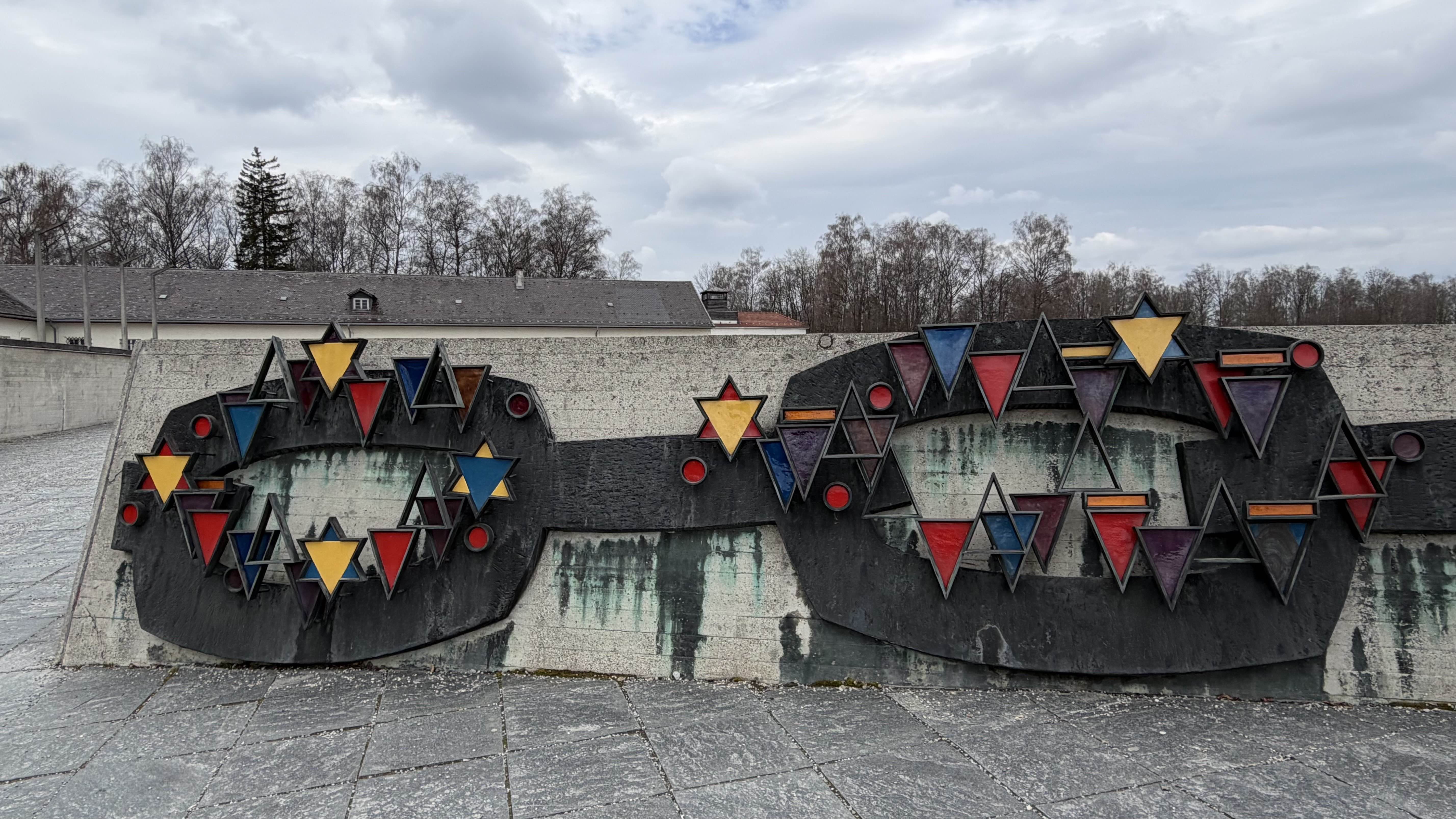
However, our tour guide mentioned that some colours are, conspicuously missing — green for criminals, black for asocials / Romani and pink for homosexuals. For a long time, these people were forgotten persecutees. Even today, many people remain unaware this history.
For instance, in Singapore, where discussion of LGBTQ issues is taboo, many in the older generation, especially those who are Christains, are swayed by talking points from American conservatives about postmodernism and how everything these days is fluid — bemoaning homosexuality and transgenderism an essentially modern phenomena brought about by the woke left. Few are aware of the rich history of queer people and their resillience in the face of oppression, including during the Holocaust.
That these people were forgotten was no accident. The memory of their oppression by the Nazis was delibrately erased in the post-war years. Due to lingering prejudices, their imprisonment in concentration camps was deemed by the post-war German government as justified, as horrifying as that sounds. I will focus on the plight of LGBTQ individuals here, but a similar narrative applies to the other groups, where they had to fight tooth and nail to obtain compensation and to get society to recognise that they too, were victims.
Paragraph 175, which criminalised sex between men, originated from Prussia and was made law across all Germany when it was unified by Bismarck, even in Bavaria and the Rhineland whereall laws prohibiting consensual sexual activities had been repealed under the influence of the French Revolution (Whisnant, 2016). Despite this, 1920s Berlin was known as one of the most LGBTQ-friendly places at the time, with a vibrant gay scene, replete with bars, restaurants and other meeting points for queer folk (Whisnant, 2016b). Groundbreaking research was also being performed at Hisrchfield’s Institute for Sexology, with the first complete gender-affirming surgery being performed there in 1931.
This all came crashing down when the Nazis came in power in 1933. Hisrchfield’s Institute for Sexology was one of their first targets, with German Student Union attacking the institute in April that year. Tens of thousands of items were burnt in the streets of Berlin by the students and the SA for being “un-German” (Whisnant, 2016c). In 1935, the Nazis, who considered homosexuality “a racial threat to the procreation of the German Volk” and political enemies, revised Paragraph 175 to enforce harsher penalties and to cast a wider net. As Newsome writes (Newsome, 2022),
Jake Newsome, Pink Triangle Legacies: Coming Out in the Shadow of the Holocaust
… the finalized version of the amended Paragraph 175 read, “A man who commits indecency with another man, or allows himself to be misused indecently, will be punished with prison.” The language was purposely vague, allowing prosecutors and judges to define “indecency” as they wanted and to convict as many men as possible. Moreover, the new version of the law also criminalized both men involved, whereas previously, the “passive” participant had almost always been understood as a victim and was therefore not in danger of conviction. Beginning in the summer of 1935, anything from sex or mutual masturbation to a quick kiss or a touch that lingered too long could land a man in prison. A 1944 legal commentary stated that it was “not necessary that a physical contact has taken place”; it sufficed if homosexual behavior was “even just intended.”
The new version of the law led to skyrocketing numbers of homosexual men being arrested, with the number of convictions rising by 740% when compared to the annual number of convictions during the Weimar era. Lesbian women or trans-people were also not safe from persecution. They could be arrested for creating a “public nusiance” by cross-dressing. Social stigma also made it harder for them to get jobs, forcing them into homelessness and leading to them being arrested under vagancy laws (Newsome, 2022b). Following their arrest and conviction, most of these people would find themselves in a concentration camp, wearing a pink triangle for homosexual men or a black triangle as the rest tended to be classified as “asocials”.
In 1945, with the surrender of the Nazis, the Allies began denazifiying Germany’s judicial system. They went through the laws passed by the Nazis and eliminated those that were deemed to be discrimatory. There was hope amongst gay men that the Allies would strike down Paragraph 175 and liberate them from the past 12 years of Nazi oppression. Unfortunately, it was left completely untouched, without even reverting to the version of the law from the Weimar Republic. This was likely due to homophobic laws and attitudes in the Allies own countries. All those who had been imprisoned for sexual indeceny would have to continue serving out their remaining sentences (Newsome, 2022c).
The Allies’ choice to leave Paragraph 175 as it stood was seen as an implicit endorsement and was subsequently cited by German courts as justification for the continued enforcement of the law. This had a chilling effect on the post-war discourse. While other persecuted groups were now free and fought hard for recognition, gay men continued to be imprisoned and silenced. Any who spoke out about their experiences, would be admitting to activities which were still illegal. The prevailing homophobic attitudes of the public did not help either as they would lend little weight to their voices 9.
In 1956, West Germany passed the Federal Compensation Act which superseded a similar law passed in 1953. The law, as previously mentioned, only provided compensation to those living in Germany who were persecuted on racial, religious or political grounds. This notably excludes forced labourers as well as gay men. Other groups who were denied any compensation also included the Roma and Sinti, peoples with disabilities and victims of medical experiments and euthanasia programs. Lesbians who applied for compensation under recognised categories also found their applications rejected due to their sexuality. For these groups, it seems the end of the Third Reich was less liberation and more of a mere change in leadership (Newsome, 2022d).
However, the coming 60s were a time of change. It saw the rise of anti-authoritarian and anti-imperialist movements across the world, from civil rights movement in the US, student protests in France and Japan to the Prague Spring in Czechslokavia. A new generation of activists, largely born after the Second World War were out on the streets protesting and fighting for their rights. It was in this atmosphere that Germany’s gay liberation movement was born. Instead of merely claiming the right to engage in consensual sexual activity in private, as previous homophile groups had done, the new movement proclaimed that people of all sexual orientations have the right to express their sexuality freely and openly. They adopted the pink triangle, once worn by gay prisoners in Dachau, as their symbol (Newsome, 2022e). It drew attention to the oppression of queer people in Germany’s recent past, which remained unresolved, and emphasised the continued marginalised of LGBTQ individuals in the present.
In Dachau, these groups fought for their recognition. In 1976, during a meeting of homosexuals in Munich, a man ran across the memorial site naked to the International Monument and demanded compensation for gay men who were imprisoned in the camps. In 1977, the “National Working Group Repression against Gays” sent letters to the Dachau survivors commitee to explain why no pink triangle was found on the relief at the International Monument (Marcuse, 2001b). The Sinti and Roma also staged a protest in Dachau, going on a hunger strike in 1980 to demanding the recognition of that they too were victims of a genocide by the Nazis, that discrimatory registration practices against the Sinti and Roma were immediately terminated and the release of files on the Sinti and Roma which were compiled by the Nazis (Central Council of German Sinti and Roma, 2020).
These efforts eventually paid off with the full repeal of Paragraph 175 in 1994. In 2000, the German government issued a unianimous resolution that stated that their failure to repeal Paragraph 175 after 1945 was a violation of human dignity. In 2002, convictions under Paragraph 175 from the Nazi era were finally annulled. Then finally, in 2017, the German government annulled convictions under Paragraph 175 which were issued after 1945 and paid reparations to those affected, admitting just not its predecessor’s, but its own wrongdoing 10 (Braun, 2021).
However, much remains to be done. The Sinti and Roma still face systemic discrimination, not just in Germany, but all across Europe, with 80% continuing to live below the poverty line (European Parliament, 2020). In Germany, same-sex unions have yet to achieve complete marriage equality with heterosexual couples and the rights of the LGBTQ community are coming under attack with the rise of the far-right AfD.
When we remember the Holocaust, we must remember that it was not just the Jews who sufferred, but also the Romani, gays and lesbians, disabled people and forced labourers. Their experiences and suffering for far too long have been pushed to the margins by a society which refused to see their humanity. And today, their hard-fought rights are once again coming under attack by far-right groups across the world who seek to turn the clock back to a mythologised past where these people play no part. Remember that never again does not mean never again only for some.
Are We Still Haunted?
Ask someone to point to the greatest and most brutal act humans have ever done and most will point to the Holocaust, and rightfully so. The Holocaust occupies a unique place in our memory as the culmination of escalating human brutality enabled by modern technology — its depths of depravity undeniable by anyone except the most ardent neo-Nazis.
However, the atrocities carried out within the colonies that preceded it often fall by the wayside, covered up by governments who only seek to whitewash their own genocidal history. The rise of Nazism was not an aberration as many like to pretend today, but rather a natural consequence of centuries of colonial expansion and the development of Orientalist notions about other peoples to justify European domination. As the Martinican poet Aime Cesaire writes,
Aime Cesaire, Discourse on Colonialism
And then one fine day the bourgeoisie is awakened by a terrific boomerang effect: the gestapos are busy, the prisons fill up, the torturers standing around the racks invent, refine, discuss. People are surprised, they become indignant. They say: “How strange! But never mind — it’s Nazism, it will pass!” And they wait, and they hope; and they hide the truth from themselves, that it is barbarism, the supreme barbarism, the crowning barbarism that sums up all the daily barbarisms; that it is Nazism, yes, but that before they were its victims, they were its accomplices; that they tolerated Nazism before it was inflicted on them, that they absolved it, shut their eyes to it, legitimised it, because, until then, it had been applied only to non-European peoples; that they are responsible for it, and that before engulfing the whole edifice of Western, Christian civilisation in its reddened waters, it oozes, seeps, and trickles from every crack.
In fact, Hitler was encouraged by the perputrators of such acts. It is well-known that Nuremberg Race codes were inspired by the Jim Crow laws of the American South. The German concept of Lebensraum is clearly a settler colonial project, with claims that the German race have the right to evict indigenious peoples to obtain more living space, echoing America’s Manifest Destiny. The failure to take action against these colonial atrocities led Hitler to believe he too could get away scot-free. In a now infamous quote, he speaks of the Armenian genocide carried out by the Ottomans (which to this day Turkey denies ever happened),
Adolf Hitler, Obersalzberg Speech
Who after all is today speaking about the destruction of the Armenians?
And today, the Holocaust is over. But the victims of colonialism, from forced labourers in the Congo Free State to the children who were forcibly enrolled in Indian boarding schools, remain in bondage. Even after decolonisation, their countries and peoples are trapped by the shackles of neocolonialism, the natural resources of their countries still being stripped away and sent to the global North. The immense wealth of the developed world was and still is built on the backs of these slaves — and yet, the West refuses to consider reparations, with US stating that it “does not recognise a legal right to reparations for historical wrongs that were not illegal under international law at the time they occurred” (United States Mission to the United Nations, 2026).
Native Americans and other indigenous groups around the world remain disenfranchised and marginalised. They have shorter life expectancies, receive significantly lower incomes and many are stuck behind bars due to police violence. Even today, their treaty rights are still being violated by multinational companies who only care about the inflow of cold, hard cash.
Simply put, the horrors of colonialism simply do not end as cleanly as the Holocaust did in 1945 with the surrender of the Nazis. The story of the Holocaust conveniently paints the Western allies as liberators of European peoples from the tyrannical Nazis (note that I’m not saying this is untrue). The victims have at least received some semblence of closure, such as through reparation payments, and concentration camps have been converted to memorial sites so that we never forget.
In contrast, the effects of colonialism echo till today and in many places, the exploitation has not ended. Some nations, like Israel, even dare to use the memory of the Holocaust, to shield itself from criticism and manufacture consent for the genocide in Gaza. Apparently never again was meant only for Jews.
Thus, while the Holocaust may be behind us, the ghosts of Dachau, of Austerlitz, of Buchenwald, continue to haunt us. The same fascistic and dehumanising impulses that paved the road to such wanton bloodshed are still present today. As Han Kang writes in Human Acts, a novel about the utter brutality of the Gwangju Massacre,
Han Kang, Human Acts
Is it true that human beings are fundamentally cruel? Is the experience of cruelty the only thing we share as a species? Is the dignity that we cling to nothing but self-delusion, masking from ourselves this single truth: that each one of us is capable of being reduced to an insect, a ravening beast, a lump of meat? To be degraded, damaged, slaughtered—is this the essential fate of humankind, one that history has confirmed as inevitable? … I heard a story about one of the Korean army platoons that fought in Vietnam. How they forced the women, children, and elderly of one particular village into the main hall, and then burned it to the ground. Some of those who came to slaughter us did so with the memory of those previous times, when committing such actions in wartime had won them a handsome reward. It happened in Gwangju just as it did on Jeju Island, in Kwantung and Nanjing, in Bosnia, and all across the American continent when it was still known as the New World, with such a uniform brutality it’s as though it is imprinted in our genetic code. I never let myself forget that every single person I meet is a member of this human race.
We must never forget that every single person on this planet, regardless of race, language, religion or sexual orientation, is a member of the human race — with lives just as rich and full of love as ours, with friends and family who care about them and whom they care for. It is difficult to comprehend the scale of tragedy and human suffering in Gaza, in Sudan, in Xinjiang. The human mind already barely process the grief from a single death. In the face of thousands, millions of deaths, remember that every death is a tragedy.
A famous poem by Martin Niemöller reflects on the horrors carried out under the Nazi regime,
Martin Niemöller, First They Came
First they came for the Communists
And I did not speak out
Because I was not a Communist
Then they came for the Socialists
And I did not speak out
Because I was not a Socialist
Then they came for the trade unionists
And I did not speak out
Because I was not a trade unionist
Then they came for the Jews
And I did not speak out
Because I was not a Jew
Then they came for me
And there was no one left
To speak out for me.
People often ask why they should care about the Rohinya, the Palestinians, the Uyghurs. Am I my brother’s keeper?
Well, if we are not careful, the imperial boomerang will swing right back at us, the chickens coming home to roost. This is already playing out in the US as its military and police force, once trained to prosecute foreign wars in the Middle East, are now coming home to attack American civilians. Remember that you could be next and by then, there may be no one left to speak out for you.
We must learn that true freedom can only come all people not only do not want to be commanded but also do not want to command, when all exploitation and oppression is abolished and all people live freely as equals. We must build a society where none live in poverty, in hunger, without a roof over their heads. Fascism thrives in poverty and pain, where there is anger and despair and hopelessness. This righteous anger against the ruling class is redirected toward the marginalised, turning the working class against itself. We have to remember that no one is free until we are all free. Only then, will the ghosts of Dachau rest in peace.
Footnotes
-
“Die Wahrheit tiber Dachau,” Mtinchner Illustrierte Zeitung, 16 July 1933. This article is mentioned in the book Legacies of Dachau: The Uses and Abuses of a Concentration Camp, 1933-2001 by Harold Marcuse on page 28.
-
Article 48 of the Weimar constitution allowed the president to suspend basic civil liberties without the approval of the Reichstag in the name of public security and order. It was applied by Freidrich Ebert and Paul von Hinderburg in the 1920s and 1930s, normalising the idea that a crisis was justification for a temporary suspension of civil liberties.
-
Prisoners were divided into three groups, with more docile prisoners receiving better treatment while undisciplined and more resistant prisoners would be punished and harshly supervised.
-
Yet another example of the Orientalist steoretype of backward ultra-conservative Muslims who brutalise women being applied to the Uyghurs.
-
Dachau is an exception in this case. In other camps, forced labour only began in the mid-1930s.
-
Such tasks would include pulling the huge cement “Jew and Bigshot Roller” around the camp. However, some inmates were also assigned to perform more productive roles. By 1934, Dachau had “its own bakery and meat-processing plants, in addition to workshops for machine building, carpentry, painting, tailoring, and shoemaking” (Marcuse, 2001c).
-
The SS Main Economic and Administrative Office (SS-WHVA) was the organisation responsible for the concentration camps where prisoners had to do forced labour as well as two exterimentation camps, Majdanek and Auschwitz (Wagner, 2010).
-
instead of being used to fund the AfD as August von Finck Jr. did.
-
Something interesting that I’m omitting here is that the homophile movement was led mostly by gay men as men usually had greater access to resources. Thus, the historical narrative here is unforunately largely male-centric.
-
It appears the reparations have only been paid out of those convicted by Paragraph 175 after 1945 whereas for those convicted during the Nazi period, their convictions anulled but no reparations were paid. I have been unable to find the reason for this online.
References
- Braun, K. (2021). 4 Justice at Last: The Persecution of Homosexual Men and the Politics of Amends. In Biopolitics and Historic Justice (pp. 77–98). transcript Verlag. https://doi.org/10.14361/9783839445501-004
- Caplan, J. (2005). Political Detention and the Origin of the Concentration Camps in Nazi Germany, 1933–1935/6. In Nazism, War and Genocide (pp. 22–41). Liverpool University Press. https://doi.org/10.5949/liverpool/9780859897457.003.0002
- Central Council of German Sinti and Roma. (2020). 40th anniversary of the hunger strike of 12 German Sinti in Dachau.
- Cui, J. (2021). Eradication of Extremism Has Given Xinjiang Women More Autonomy, Says Report. China Daily.
- European Parliament. (2020). Roma: what discrimination do they face and what does EU do?
- EVZ Foundation. (n.d.). NS forced labor: Exploited and “forgotten.”
- Jong, D. de. (2022a). Nazi Billionaires: The Dark History of Germany’s Wealthiest Dynasties (pp. 234–238). William Collins.
- Jong, D. de. (2022b). Nazi Billionaires: The Dark History of Germany’s Wealthiest Dynasties (pp. 230–231). William Collins.
- Jong, D. de. (2022c). Nazi Billionaires: The Dark History of Germany’s Wealthiest Dynasties (pp. 203–205). William Collins.
- Jong, D. de. (2022d). Nazi Billionaires: The Dark History of Germany’s Wealthiest Dynasties (pp. 217–218). William Collins.
- Jong, D. de. (2022e). Nazi Billionaires: The Dark History of Germany’s Wealthiest Dynasties (pp. 221–223). William Collins.
- Jong, D. de. (2022f). Nazi Billionaires: The Dark History of Germany’s Wealthiest Dynasties (pp. 279–280). William Collins.
- Jong, D. de. (2022g). Nazi Billionaires: The Dark History of Germany’s Wealthiest Dynasties (p. 281). William Collins.
- Marcuse, H. (2001a). Legacies of Dachau: The Uses and Abuses of a Concentration Camp, 1933-2001 (p. 21). Cambridge University Press.
- Marcuse, H. (2001b). Legacies of Dachau: The Uses and Abuses of a Concentration Camp, 1933-2001 (pp. 353–354). Cambridge University Press.
- Marcuse, H. (2001c). Legacies of Dachau: The Uses and Abuses of a Concentration Camp, 1933-2001 (p. 26). Cambridge University Press.
- Newsome, W. J. (2022a). Pink Triangle Legacies: Coming out in the shadow of the Holocaust (p. 38). Cornell University Press.
- Newsome, W. J. (2022b). Pink Triangle Legacies: Coming out in the shadow of the Holocaust (pp. 40–43). Cornell University Press.
- Newsome, W. J. (2022c). Pink Triangle Legacies: Coming out in the shadow of the Holocaust (p. 60). Cornell University Press.
- Newsome, W. J. (2022d). Pink Triangle Legacies: Coming out in the shadow of the Holocaust (pp. 76–78). Cornell University Press.
- Newsome, W. J. (2022e). Pink Triangle Legacies: Coming out in the shadow of the Holocaust (pp. 89–92). Cornell University Press.
- Ruser, N., & Leibold, J. (2021). Family de-planning: The coercive campaign to drive down Indigenous birth-rates in Xinjiang (ASPI International Cyber Policy Centre). Australian Strategic Policy Institute.
- Smith Finley, J. (2020). Why Scholars and Activists Increasingly Fear a Uyghur Genocide in Xinjiang. Journal of Genocide Research, 23(3), 348–370. https://doi.org/10.1080/14623528.2020.1848109
- Tiezzi, S. (2021). What Do Chinese People Think Is Happening in Xinjiang? The Diplomat.
- United States Mission to the United Nations. (2026). Explanation of Vote for UNGA Resolution “Declaration of the Trafficking of Enslaved Africans and Racialised Chattel Enslavement of Africans as the Gravest Crime Against Humanity.”
- Wachsmann, N. (2016a). KL: A history of the Nazi concentration camps (edition 2016, pp. 4–5). Little, Brown.
- Wachsmann, N. (2016b). KL: A history of the Nazi concentration camps (edition 2016, pp. 61–63). Little, Brown.
- Wachsmann, N. (2016c). KL: A history of the Nazi concentration camps (edition 2016, pp. 147–148). Little, Brown.
- Wagner, J.-C. (2010). Work and Extermination in the Concentration Camps. In N. Wachsmann & J. Caplan (Eds.), Concentration Camps in Nazi Germany: The New Histories (pp. 127–148). Routledge. https://doi.org/10.4324/9780203865200
- Whisnant, C. J. (2016a). Queer Identities and Politics in Germany: A history, 1880-1945 (p. 19). Harrington Park Press.
- Whisnant, C. J. (2016b). Queer Identities and Politics in Germany: A history, 1880-1945 (p. 80). Harrington Park Press.
- Whisnant, C. J. (2016c). Queer Identities and Politics in Germany: A history, 1880-1945 (p. 210). Harrington Park Press.