Recently, I finished reading Ishiguro’s newest book, Klara and the Sun. I was pretty excited to start on it, to see the fusion of science-fiction and Ishiguro’s traditional style of an unreliable narrator and I am glad to say that it did not disappoint — and I’m looking forward to the movie adaptation too!
Klara’s World
The novel is written in first-person, from the perspective of the solar-powered artificial friend (AF), Klara, who is serving a teenage girl named Josie. One of the best parts of the novel is the depiction of the world, through the lens of Klara’s mind — yet another unreliable narrator, as we find out by the book’s end — leaving us to decipher what really happened. Furthermore, unlike most science-fiction novels, Klara and the Sun is far slower and more contemplative, zooming in on the life and inner thoughts of an AF, serving a relatively ordinary upper-class girl. There are clear parallels to be drawn here with Ishiguro’s critically-acclaimed novel, The Remains of the Day, which focuses on the service of a humble butler.
Our first glimpse into Klara’s artificial consciousness comes as what seems to be a road-paving machine, known as the Cootings machine, appears outside the window of the AF store, where Klara is situated. She describes the street as being “partitioned into several vertical panels”, perhaps an artifact of her internal image processing algorithm?
Klara
When I next looked, the street outside had become partitioned into several vertical panels – from my position I could see three of them quite clearly without leaning forward. The amount of dark smoke appeared to vary from panel to panel, so that it was almost as if contrasting shades of gray were being displayed for selection. But even where the smoke was at its most dense, I could still pick out many details.
Later on, when some special fluid is removed from Klara’s “brain”, she describes the appearance of “cones and cylinders” in her vision — implying that she is somewhat disorientated and perhaps in an stressful / emotional situation.
Klara
…, their figures became more simplified, as if constructed out of cones and cylinders made from smooth card. Their clothes … were devoid of the usual creases and folds, and even their faces under the streetlight appeared to have been created by cleverly placing flat surfaces into complex arrangements to create a sense of contouring.
We again, see a description of similar artifacts again at the emotional climax (can I call it that?) of the story when Klara is desperately praying to the Sun for Josie’s recovery.
Klara
It was almost as if I were watching passing traffic in a busy street, and when I managed to throw my gaze over to the further side, I found it had been partitioned into numerous boxes of uneven dimensions.
Ishiguro takes this approach of only showing and never telling, to the limit, with almost no exposition provided throughout the book. What we know about the world is found through bits of dialogue and small observations, like little pieces of a jigsaw puzzle, perhaps intended to put us in Klara’s shoes and demonstrate her own cluelessness about the world that she inhabits.
Putting the pieces together, we see that the book is set in a dystopian cyberpunk-like society. The forces of neoliberal capitalism have been allowed to run rampant, further weakening communal bonds and alienating people from each other. Children of Josie’s age (the ones born into wealth at least) do not seem to go to school anymore but rather are tutored online, deprived of real human connection. To learn social skills, their parents organise interaction meetings with other children. The process of lifting appears to be a form of genetic enhancement that comes with a high-risk of unknown health complications and even death. Yet, is a requirement for any form of social mobility in this society, with even bright unlifteds like Rick being unable to secure a place in college — creating an effective underclass without opportunities because they decided not to gamble with their lives.
In their pursuit of ever greater profits, corporations have used AI to replace many jobs, swelling the ranks of those called the “post-employed”. The indifferent of elites to their plight is laid bare as we find out plans for the Oxford Building will kick out “four hundred and twenty-three post-employed people living inside it, eighty-six of them children”, leaving them without a roof over their heads. And all this probably just to feed the instantiable greed of a couple of billionaire investors.
The impoverishment of these people is likely responsible for the anti-AF sentiment and the implied fascist movement that Josie’s father is involved in, though he vehemently denies any “fascistic-leanings”, claiming that his community has “some very fine people”. In many ways, this world uncomfortably close to home. From tech-fuelled loneliness epidemic to the rise of fascists and the increasing impoverishment of the working-class, it is a warning of everything that could go wrong.
The Worship of the Sun
To me, the most relatable part of the book, the part that stood out to me, was Klara’s almost paganistic worship of the Sun. The see this focus on the Sun right as the book opens, with Klara referring to the Sun’s nourishment, implying that all the AFs are solar-powered.
Klara
When I was lucky enough to see [the Sun] like that, I’d lean my face forward to take in as much of his nourishment as I could, and if Rosa was with me, I’d tell her to do the same.
This obsession with the Sun continues as Klara observes a homeless man and his dog, who she thought had died but were probably just napping, waking up as the Sun came out of the clouds.
Klara
The Sun was pouring his nourishment onto the street and into the buildings, and when I looked over to the spot where Beggar Man and the dog had died, I saw they weren’t dead at all – that a special kind of nourishment from the Sun had saved them.
This incident, which to most people would clearly be a mere coincidence, as something mundane, then becomes a crucial part of her undying faith in the Sun. We see this again as the Sun comes out while Coffee Cup Lady and Raincoat Man lovingly embrace across the street from Klara’s store, leading Klara to believe that it was the Sun that reunited them.
Klara
Then the Coffee Cup Lady reached the RPO Building side, and she and the man were holding each other so tightly they were like one large person, and the Sun, noticing, was pouring his nourishment on them.
There are many parallels between Klara’s behaviour and typical religious behaviour in humans. Across the story Klara constantly personifies the Sun. When the Cootings machine (which is really just a machine used to help with road works) arrives just outside the AF store and blocks out the Sun, she says “the Sun, I knew, was trying his utmost”. Later she goes on to view the machine as the Sun’s “enemy” due to its production of Pollution and attempts to destroy it to appease the Sun — similar to how humans across many religious traditions offer sacrifices in order to gain something from their God.
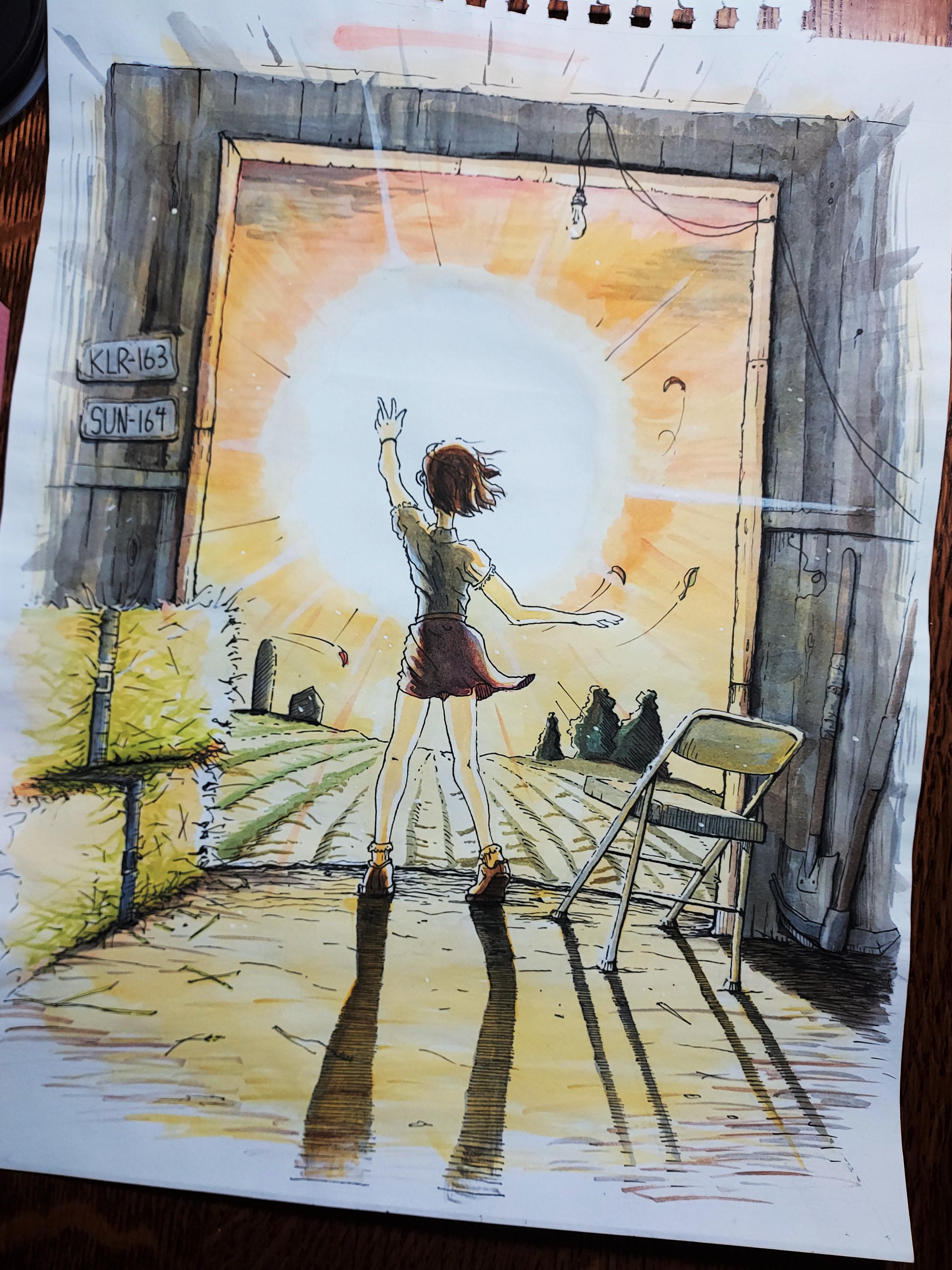
Later, Klara visits the barn outside Josie’s house (she does this twice), which she concluded must be the Sun’s resting place. The barn serves as the equivalent of a place of religious worship, like a temple or a church. Here in the aftermentioned climax of the book, with Josie’s condition slowly deteriorating, she tearfully (well the equivalent of tearfully for a robot) petitions the Sun to send his “special help” which he showed to Beggar Man, to heal Josie’s sickness. As she first steps foot into the barn, we see her memories begin to bleed into each other, perhaps a result of her heightened emotions or due to her memory malfunctioning with some fluid removed.
Klara
Beyond the hay blocks was the real wall of the barn, and I was pleased to see the Red Shelves from our old store still attached to it, though this evening they’d become crooked, slanting noticeably towards the rear of the building. The ceramic coffee cups had maintained their orderly line, but there were also signs of confusion: for instance, further on the same tier, I could see an object that was unmistakably Melania Housekeeper’s food blender.
One day after Klara’s final prayer at the barn, Josie has a seemingly miraculous recovery, appearing to begin with the Sun shining into her room. This is interpreted by Klara as being caused by the Sun answering her prayers, and giving his special help and nourishment to Josie. There is a strong parallel here to human belief in miracle healing. A fairly obvious logical fallacy, known as the post hoc fallacy, is being made here, which is that since event B occurred shortly after event A, event B caused event A. However to a religious person, there would be no doubt in their mind as to who would responsible, if after going to a faith healing event, they recovered from their sickness, not least due to the emotional weight that was lifted.
For instance, I know a Christian who said that her childhood asthma went into remission shortly after attending such a faith-healing event, becoming one of the central reasons to believe. Approaching this from a secular perspective, there are several reasons to be doubtful of this. Firstly, it is fairly common for childhood asthma to go into spontaneous remission (that’s what happened to mine). Second, these faith-healing events are widely known to be scams, with the evangelical preachers carefully selecting who would be allowed to go on stage to be prayed for or having information about the patient’s condition to be secretly told to the preachers on stage. Furthermore, just like in Klara’s case, this story is being recounted many years after the original incident. The fog of time could lead to exaggerations, especially due to how emotionally charged the memory is. The time between the asthma going into remission and the time of attending the faith-healing could be misremembered as being shorter than it actually was.
There is also an inherent tension in Klara’s spiritual beliefs — how could a creature born of science, able to teach Rick advanced physics, come to worship the Sun religiously? While there is certainly a difference in belief in the Sun as a deity and belief in a God, I believe this is reflective of how even some of the smartest people, such as Georges Lemaître, are religious (not that there’s anything wrong with that). Being raised as Christian, there was always a lingering feeling about my own scientific knowledge conflicting with religious doctrine such as the creation of the world in 7 days. Just as we resolve such conflicts by re-interpreting scripture and or by keeping the spheres of science and religion separate, Klara does the same. She likely views the religious and spiritual powers that she has assigned to the Sun as separate from the scientific understanding of the Sun as a ball of fire at the centre of the Solar System.
The Digital Afterlife
The specter of Josie’s mortality looms over most of the book. Her mother, already broken by the loss of her first child, Sal, works with Mr Capaldi to turn Klara into a replacement Josie, should her real daughter pass away from the sickness. In fact, she already tried this once with her first daughter Sal.
Mr Capaldi
What we did with Sal is no comparison. We’ve been through this, Chrissie. What we made with Sal was a doll. A bereavement doll, nothing more. We’ve come a long, long way since then. What you have to understand is this. The new Josie won’t be an imitation. She really will be Josie. A continuation of Josie.
The use of technology to try and cope with grief, to keep loved ones alive beyond the grave is nothing new. It is not uncommon for people to listen to voicemails and audio recordings or to read old messages from the deceased to cope with the immense grief of losing someone. With the advent of ChatGPT and other similar large language models, a digital afterlife industry is emerging to help people with their grief. This is eeriely similar to Mr Capaldi’s bereavement doll — and even to Chrissie’s plan to permanently replace Josie should she pass on.
Just before reading the book, I happened to watch this excellent video by Art Chad discussing the phenomenon of AI psychosis, including the emerging digital afterlife industry and the ideology of transhumanism. The video talks about the case of Joshua and how using Project December, he constructed a chatbot to speak with the same mannerisms like his late fiancee, Jessica. After trying and failing to tell the chatbot it was not really Jessica, he became fully immersed in the simulation, speaking to the chatbot as if it was really her.
There is something deeply disturbing about seeing this technology, once only contained in the pages of science-fiction novels, being developed and used in real-life. It is frightening that otherwise normal people can become sucked into the illusion and believe that the chatbots in some sense really are their loved ones. And worst of all — tech companies taking advantage of people when they are most vulnerable, who are grieving for the loved ones, to sell them an uncanny imitation of the deceased, not to mention issues with privacy and consent from the deceased. And it raises an even more fundamental question — with sufficiently advanced technology like we see in Klara and the Sun, could such a clone ever truly replace the real person?
Mr Capaldi seems to think so. He says to Josie’s mother, Chrissie,
Mr Capaldi
A part of us refuses to let go. The part that wants to keep believing there’s something unreachable inside each of us. Something that’s unique and won’t transfer. But there’s nothing like that, we know that now. You know that. For people our age it’s a hard one to let go. We have to let it go, Chrissie. There’s nothing there. Nothing inside Josie that’s beyond the Klaras of this world to continue. The second Josie won’t be a copy. She’ll be the exact same and you’ll have every right to love her just as you love Josie now. It’s not faith you need. Only rationality.
He believes that our unwillingness to accept a digital clone as a real person due to sentimentality and is fundamentally irrational. He believes that most of us simply can’t let go. In the book, he gives Klara a questionnaire to do, to test her abilities, in order to scientifically prove Klara is “well on her way to accessing quite comprehensively all of Josie’s impulses and desires”. Yet, suppose Klara could fully mimic Josie’s neural patterns, memories and mannerisms, could she really be the same as the original Josie?
This parallels the well-known philosophical paradox of the Ship of Theseus, about a ship that is continuously repaired over time until it contains no more material from the original ship. Would the new ship still be the same Ship of Theseus? What about a ship reconstructed from the original parts of the Ship of Theseus? The paradox deals with whether identity lies in the physical matter, the form / structure, or some continuous essence.
This is exactly what Paul, Josie’s father, asks Klara, after discussing Mr Capaldi informs her of his plans for Klara to replace Josie, should she pass on.
Paul
Let me ask you this. Do you believe in the human heart? I don’t mean simply the organ, obviously. I’m speaking in the poetic sense. The human heart. Do you think there is such a thing? Something that makes each of us special and individual? And if we just suppose that there is. Then don’t you think, in order to truly learn Josie, you’d have to learn not just her mannerisms but what’s deeply inside her? Wouldn’t you have to learn her heart?
At the end of the book, Klara eventually concludes that there is something special, something that can’t be transferred. However, it isn’t in Josie but rather in those who loved her.
Klara
Mr Capaldi believed there was nothing special inside Josie that couldn’t be continued. He told the Mother he’d searched and searched and found nothing like that. But I believe now he was searching in the wrong place. There was something very special, but it wasn’t inside Josie. It was inside those who loved her. That’s why I think now Mr Capaldi was wrong and I wouldn’t have succeeded. So I’m glad I decided as I did.
I am inclined to agree with Klara here. A robotic reanimation of the deceased, even if somehow scientifically proven to have the same behaviours, emotions and memories as the real person, can never truly fill the void left behind. As Klara says, “I’d never have reached what they felt for Josie in their hearts”. The original stream of consciousness that filled the original person is gone. The person is dead. It is impossible to expect anyone to be able to treat some mechanical recreation as the same person. The knowledge that the original has passed forever taints the replica. There will always be something lost, something special that wasn’t transferred — lying as Klara said not in some kind of “soul” within the deceased but in our capacity of those greiving to love and be loved. Perhaps it is pure sentimentality, but humans are not rational creatures.
Love in a Broken World
Even in the broken, dystopian world of Klara and the Sun, the novel focuses on love and how it has been corrupted by the crushing social expectations of their society. There is still joy and happiness amidst the shell of society Klara finds herself in. It reminds me of a quote from one of my favourite books, The Testaments.
Agnes, The Testaments
I imagine you expect nothing but horrors, but the reality is that many children were loved and cherished, in Gilead as elsewhere, and many adults were kind though fallible, in Gilead as elsewhere. I hope you will remember, too, that we all have some nostalgia for whatever kindness we have known as children, however bizarre the conditions of that childhood may seem to others.
We see a fierce love for Josie in her mother, though it is warped by the social pressures of her society. In wanting the best for her future, she decides to it is worthwhile to risk losing it all. She decides to gamble with her daughter’s life (go through the process of lifting), even after her first child passes away from a mysterious illness caused by the lifting process.
Chrissie
… from the moment I first held her, everything about her told me she was hungry for life. The whole world excited her. That’s how I knew from the start I couldn’t deny her the chance. She was demanding a future worthy of her spirit. That’s what I mean when I say she played for high stakes.
Her intense stress about Josie’s sickness also leads her to treat Josie cruelly. After promising to bring both Klara and Josie to Morgan Falls on Sunday if Josie recovers, she decides Josie is too sick to go and she only brings Klara to the waterfall despite knowing that it would hurt Josie’s feelings. She even considers replacing Josie with an AF modelled after her appearance should she pass on — which was the entire purpose of purchasing Klara. I find it rather disturbing that a mother would be willing to go through with something like this, to treat her daughter as so replaceable.
Despite this Josie still loves her mother and is appreciative of her mother’s courage to allow her to go through the lifting process. As conveyed by Rick to her mother, while she was bedridden and perhaps even close to death,
Rick
She says that no matter what happens now, never mind how it plays out, she loves you and will always love you. She’s very grateful you’re her mother and she never even once wished for any other. That’s what she said. And there was more. On this question of being lifted. She wants you to know she wouldn’t wish it any other way. If she had the power to do it again, and this time it was up to her, she says she’d do exactly what you did and you’ll always be the best mother she could have.
The most earnest and pure love we see between humans in the book is between Rick and Josie, two childhood friends. Their “plan”, presumably to go to college together, get married and be together is brought up throughout the book. Although Rick is unlifted and Josie is, they have vowed to love each other forever inspite of their difference in social class.
We see moments of tender love between the two, especially when they are playing the “bubble game”. Josie, bedridden due to her illness, draws pictures of themselves and others, along with speech and thought bubbles for Rick to fill up. This acts as a way for them to communicate their thoughts about each other and the people around them, and share their perspectives with each other. Unlike Josie’s mother, and so many other parents, who push their ideas and desires onto their children, Rick and Josie build their love on mutual understanding and concern for each other.
In fact, during the Bubble Game, Rick writes the following as Josie’s thoughts to satirise Josie’s placid acceptance of her mother’s plan to lift her.
Rick
I wish I could go out and walk and run and skateboard and swim in lakes. But I can’t because my mother has Courage. So instead I get to stay in bed and be sick. I’m glad about this. I really am.
This causes them to have a short fallout with each other, like two quarrelling siblings, though they eventually get back together again. In the end, however, their lives ultimately drift apart. Josie is able to attend college as she is lifted while Rick is unable to secure a place at Atlas Brookings (the only college that takes in unlifteds). As this review put it, “even love cannot transcend the dynamics of class”.
The End
Klara
Over the last few days, some of my memories have started to overlap in curious ways.
At the end of the book, Josie recovers and goes to college. The scene is reminiscent of Pixar’s Toy Story 3, when Andy is going to college, forcing Woody to grapple with the fact that his child no longer needs him.
Some time later, Klara finds herself in a junkyard, staring at the sky, going through her memories and placing them into the right order. I feel a sense of injustice at this outcome. After all that Klara had been through, she is ultimately treated as nothing more than a “vacuum cleaner” as Rick’s mother puts it. She is ultimately discarded like an old machine, despite very clearly demonstrating her humanity throughout the book. This is not the only time that we see AFs being abused in the book. At Josie’s interaction meeting, some of the children threaten to throw Klara across the room, commenting that their own AF always lands on their feet. Or when Klara is looking outside the store window and sees an AF “walking three paces behind” its owner and that “this was how the girl had decided they would always walk”.
This also reminds me of a quote from the manager at the start of the book.
The Manager
Children make promises all the time. They come to the window, they promise all kinds of things. They promise to come back, they ask you not to let anyone else take you away. It happens all the time. But more often than not, the child never comes back. Or worse, the child comes back and ignores the poor AF who’s waited, and instead chooses another. It’s just the way children are.
Well its the way most humans are, fickle and forgetful. Although it was Josie who told Klara that “she’ll never let anything bad happen to her”, she breaks her promise to Klara by callously dumping her in a junkyard. Despite everything Klara had done for her, she simply leaves her to rot — which ultimately goes to show just how cruelly humans will treat anything which they believe to be beneath them, whether it be pets, robots or even other humans.
At least we can take comfort in the fact that Klara herself feels no sadness, no despair, no longing for the past. She seems content to continue staring at the sky, fading away.