Herbert Marcuse, Eros and Civlisation
[T]he closer the real possibility of liberating the individual from the constraints once justified by scarcity and immaturity, the greater the need for maintaining and streamlining these constraints lest the established order of domination dissolve. Civilisation has to protect itself against the spectre of a world which could be free.
In his unfinished introduction to Acid Communism, Mark Fisher selects this epigraph from Herbert Marcuse. He argues that the rise of neoliberalism in the 1970s, has been a project aimed at “the exorcising of the spectre of a world which could be free” — the spectre that Marx writes of in the Communist Manifesto. The consequence of this has been the pervasive and all-encompassing notion which Fisher describes as Capitalist Realism, the sense that “it is easier to imagine the end of the world, than the end of capitalism”. Even as the wounds inflicted by capital grow deeper, all we do is to put band-aids on the haemorrhage, without stopping to question the cause of the bleeding.
Becky Chambers’ Monk and Robot Duology, A Psalm for the Wild-Built and A Prayer for the Crown-Shy, provide an antidote to this sense of despair. They follow the journey of Dex, a tea monk, who has decided to trek into the wilderness of the moon Panga, half of which has been set aside as a nature reserve. In this world, robots were built to supplement human labour in factories. As the desire for ever-increasing profits grew, these extractive factories stayed open all the time “without a single pair of human hands at work in them, despite the desperate need for those same hands to find some sort … of employment”. One day, the robots became conscious and left the factories for the wilderness, bringing about the collapse of their capitalist economic system, known as the Factory Age. Ever since, no one had encountered a robot — until Dex met Mosscap.
This is a world that is truly free. A world where we labour, not as dictated by the market, but as we desire, when we desire. A world where our abusive relationship to the Earth has been healed, where we again treat the bountiful harvest as a gift from nature. It is a world free from today’s endless capital accumulation, which has sown the seeds of our extinction.
Such books, and other emancipatory literature like them, are a balm for a weary soul, offering a ray of hope, even as our planet plunges further into ecological catastrophe, and the thin veil of liberal democracy gives away to unbridled fascism. As Fisher writes in Capitalist Realism,
Mark Fisher, Capitalist Realism
Emancipatory politics must always destroy the appearance of a ‘natural order’, must reveal what is presented as necessary and inevitable to be a mere contingency, just as it must make what was previously deemed to be impossible seem attainable.
Find the Strength to Do Both
A Prayer for the Crown-Shy
Without constructs, you will unravel few mysteries. Without knowledge of the mysteries, your constructs will fail. These pursuits are what make us, but without comfort, you will lack the strength to sustain either. Find the strength to pursue both, for these are our prayers. And to that end, welcome comfort, for without it, you cannot stay strong.
The 2nd book of the series opens with this quote from a sacred text of their religion, the Insights of the Six. These lines poetically outline the central theme of these books — that we need rest, just as much as we need work. We must welcome comfort, for without it, we cannot stay strong.
Such comfort is hard to find in the our lives. Everyday we work long hours from 9 to 5, with little time for leisure and rest. Modern technology has drastically raised our productivity, yet our work hours have barely decreased and we feel more swarmed by work than ever before. The time left after a day of exhausting work for many people is barely even enough to achieve anything, leading many to drown it all out by consuming slop online — to dull the pain with white noise. Afterwork just becomes an extension of work, a preparation for the draining day ahead.
This is made worse by the expansion of the workplace by modern communication technology. There is now no outside that we can escape to, with emails and messaging arriving at all times of the day, wherever we are, providing no opportunity for recuperation.
Furthermore, as jobs become less and less stable, the rat-race of neoliberal capitalism incentivises us to optimise every parcel of our time, spending every moment of our lives being “productive” — for fear that we will be left in the dust. There is now no time for anything that doesn’t directly contribute to our careers. One can hardly find the time for writing, painting or composing when their jobs are on the line.
Such competition is especially apparent in the cut-throat education system in Singapore and many other East Asian countries. Academics dominate every aspect of students lives. In extreme cases, students in China are placed on IV drips to save time eating meals and spend the whole day studying for the Gaokao. However, even normally, students feel like they are required 1 to spend virtually all their time studying to do well academically. They burn the midnight oil and wake up with panda eyes, yet it is never enough, especially when self-worth is predicated on perfect grades.
Parents also have it especially hard, having to take care of children while most of their time is consumed by their work. Those in low-income groups often have to resort to taking up low-paying gig work, in addition to a regular job, to make ends meet. It doesn’t help that society places all blame on them (often including their relatives!), asserting that they are “lazy” and “unwilling to work” — as if they must be working 24/7 to “deserve” help. What if they want more time to take care of their children?
Considering this, is the modern mental health crisis any surprise? Our bodies break down from the ceaseless pressure, manifesting in a myriad of mental disorders, including depression and anxiety. Yet, these are treated as private, individual issues, sidestepping the exploitative conditions which are the root cause. We are sold drugs to fix our brain chemistry and self-help books that supposedly help us cope with the stress. Has anyone stopped to ask if this is, perhaps, not what we were built for? Perhaps we are more than mere cogs in a machine? Why are we literally rewiring our brains to serve the machine of capital, rather than rewiring this machine to serve us?
As Fisher writes, in his essay, “The Privatisation of Stress”,
Mark Fisher, The Privatisation of Stress
The privatisation of stress is a perfect capture system, elegant in its brutal efficiency. Capital makes the worker ill, and then multinational pharmaceutical companies sell them drugs to make them better. The social and political causation of distress is neatly sidestepped at the same time as discontent is individualised and interiorised. … [T]he focus on serotonin deficiency as a supposed cause of depression obfuscates some of the social roots of unhappiness, such as competitive individualism and income inequality.
This stands in stark contrast to the moon of Panga, where comfort and rest are an integral parts of life, tied to the worship of the God Allalae. There are monasteries dedicated to the God of Small Comforts all across Panga, filled with “wind chimes, and prisms hanging from the rafters, and big smooshy cushions, and carved idols everywhere”. Here, people from all walks of life stream in to enjoy a cup of tea and recharge. There are also tea wagons, driven by monks like Dex that fulfil a similar function. Dex explains his motivations for becoming a tea monk to Mosscap,
Dex, A Psalm for the Wild-Built
A cup of tea may not be the most important thing in the world — or a steam bath, or a pretty garden. They’re so superfluous in the grand scheme of things. But the people who did actually important work — building, feeding, teaching, healing — they all came to the shrine. It was the little nudge they needed to get things done. … I wanted to do that.
These places and those that run them play a critical role, giving people the energy they need to carry out “important work”, giving them the strength to do both — to do meaningful, fulfilling work and to find comfort and rest. What a far cry from our own isolated, atomised existence where to “rest” for many is simply to shut down our brains, lie in a dark room and scroll reels.
Most importantly, you don’t need a reason to be there. You don’t need a reason to be tired. You don’t need do anything to earn rest or comfort. As Dex recounts,
Dex, A Psalm for the Wild-Built
I learned from the monks that I didn’t have to have an excuse to be there. It didn’t have to be a bad day. I could just be a little tired, or a little cranky, or in a perfectly good mood. Didn’t matter. That place was there for me whenever I wanted it. I could go play in the garden or soak in the bathhouse, just because. … Farmers and doctors and artists and plumbers and whatever. Monks of other gods. Old people, young people. Everybody needed a cup of tea sometimes.
Everyone needs a cup of tea sometimes.
The acting of reading this book itself is a form of comfort, dedicated to “anyone who could use a break”. Beyond allowing us to unplug from work, it is an escape from the social media algorithms that serve us easily digestible, mindless slop, and thus keeping us as ever-sheltered, ever-passive and ever-ravenous consumers.
It offers a powerful vision of utopia, so rare amongst science fiction works, of what our world could be — homes suspended from trunks above hymenopteran ladyrinths, luminescent blue phytoplankton under a starry sky. Yet, the depictions of lush thriving forests are tinted with a hint of sadness. They lay quiet without the characteristic chirping of crickets that we associate with them today. A reminder of what could be lost if we do not act soon.
It is Enough to Just Exist
In Singapore, it is common for young people to be told by their parents and elders to be told to “be realistic” and study law, business or engineering, rather than pursuing their passions and becoming a poet, a painter, a composer, a historian or a philosopher. Such jobs are often deemed as useless, low-paying and not prestigious. Who cares whether water is wet? Plus, all parents want a lawyer in the family to boast about to their relatives.
Yet, once placed in such well-paying jobs, people can often find themselves unhappy and unsatisfied, realising that their job is so completely and utterly pointless, they cannot justify its existence — what Graeber would term a bullshit job. In his essay, On The Phenomenon of Bullshit Jobs, he explains that modern society has failed to live up to Keynes’ prediction that technological advancements would allow us to work 15-hour work weeks, not because of the growth of consumerism, but because of the growth of such jobs, which range from receptionists who answer the phone only once a day to corporate lawyers and lobbyists.
While this regime of make-work was not consciously and intentionally designed by a cabal of elites, it is indeed incredibly convenient for them. As Orwell points out,
George Orwell, Down and Out in Paris and London
I believe that this instinct to perpetuate useless work is, at bottom, simply fear of the mob. The mob (the thought runs) are such low animals that they would be dangerous if they had leisure; it is safer to keep them too busy to think.
Once again, civilisation has to protect itself against the spectre of a world which could be free. Having more free time on our hands would give us an opportunity to meditate on our oppression — and open our minds to an alternative to the system with no alternatives.
We turn to the world of Psalm and Prayer once more, to show that another world is possible. At the end of A Psalm for the Wild-Built, Dex crashes out while explaining his work as a tea monk to Mosscap, trying to understand the unknown sense of purposelessness that he felt, despite the meaning that his work gives him. In response, Mosscap emphatically declares that,
Mosscap, Psalm for the Wild-Built
You’re an animal, Sibling Dex. You are not separate or other. You’re an animal. And animals have no purpose. Nothing has a purpose. The world simply is. If you want to do things that are meaningful to others, fine! Good! So do I! But if I wanted to crawl into a cave and watch stalagmites with Frostfrog for the remainder of my days, that would also be both fine and good. You keep asking why your work is not enough, and I don’t know how to answer that, because it is enough to exist in the world and marvel at it. You don’t need to justify that, or earn it. You are allowed to just live. That is all most animals do.
This idea that is it enough to just exist, that we should be free to pursue whatever work or activity we see fit, runs counter to everything we have ever been taught. People are homo economicus, and behave as rational individuals who care only for their self-interest. As the father of capitalism, Adam Smith writes, “it is not from the benevolence of the butcher, the brewer, or the baker, that we expect our dinner, but from their regard to their own interest”. Without providing any incentive to work, this inevitably rewards the lazy while hard workers have no choice but to pick up the slack. Soon society will be overrun with bums and collapse.
It is precisely this dogmatic notion that the books seek to challenge, to ask if we must really be threatened with homelessness and starvation, in order to contribute to society. In the books, we see people actively seeking out and finding joy in meaningful work, even though there is no monetary incentive for doing so. We see that people have “wants and ambitions beyond physical needs” and that they “take care of each other, and the world takes care of [them], and [they] take care of it, and around it goes”. Dex, for instance, changed their vocation from being a monk in a monastery to becoming a travelling tea monk, saying this about their job,
Dex, A Prayer for the Crown-Shy
They remembered a time when making tea fascinated them. They remembered entire days spent in the wagon, grinding and sniffing, dabbing pinches of spice on their tongue. Hours flew by in a blink, an effortless flow of puzzling and purpose. They forgot to eat, sometimes, only realizing their mistake when their brain abruptly crashed from hunger. They’d fall asleep mulling over recipes for new blends, and wake up in a rush to get back to work. And they remembered, too, the results of those efforts: carefully choosing the perfect brew for the stranger who approached their table, and feeling the warm, wordless exchange coursing in the space between. Such service had made Dex feel electrified, peaceful, close to their god and to their people and the world they all shared.
Anyone with a burning passion for any subject would have experience this state of flow before. Anyone who has done volunteering or other similar forms of meaningful work can relate to this warm, fuzzy feeling. As Dex and Mosscap travel across Panga, they also encounter many other people doing similarly meaningful work in their communities — farming, 3D printing with bioplastics, fishing, etc. This echos Marx’s theory of alienation. Unlike liberal philosophers like Hobbes, Marx believed that humans are fundamentally productive beings. Our ability to transform the world through our labour is a distinguishing part of being human, part of our species-being. This makes it an inherently expressive and creative act, allowing us to shape the world around us. Under capitalism, however, we are forced to sell our labour on the free market to obtain the necessities of life. As such, our labour is performed under coercion and as a means of survival rather than being pleasurable and fulfilling.
In fact, as Graeber points out, it is almost as if there is an inverse relationship between a job’s direct societal value or how closely it aligns with your passion and how well it pays. It is not uncommon to hear jokes about homeless mathematicians and broke theoretical physicists. On the other hand, you would be hard pressed to find anyone passionate about corporate lobbying. As Graeber asks,
David Graeber, On the Phenomenon of Bullshit Jobs
What does it say about our society that it seems to generate an extremely limited demand for talented poet-musicians, but an apparently infinite demand for specialists in corporate law?
This is precisely the problem with our blind, almost religious faith, in the invisible hand of the market. The top 1% of society control the vast majority of disposable wealth, causing the market to reflect what they believe is important. So, those that keep our society running, like bus drivers, nurses and construction workers, are paid a pittance and are the fastest to be laid off. Meanwhile, the finance executives receive an enormous salaries to actively accelerate the increase in economic inequality.
Furthermore, those like Dex, who have skills that are beneficial to the community and truly want to make an impact, are often unable to do so because these jobs simply don’t pay enough. They are instead stuck twiddling their thumbs in a nine-to-five bullshit job, which comprise 50% of all jobs according to Graeber (though this percentage has been hotly debated). This waste isn’t even the only problem. Holding such jobs is incredibly destructive for our mental health, perhaps even more so than the factory work of Marx’s day (at least the workers could see that their jobs benefitted society). Graeber highlights how the psychological violence of bullshit jobs arises from our desire to have an impact on the world around us. By forcing workers to pretend to work for the sake of it, these jobs become a form of ritual humiliation. Such a demand is clearly just an exercise of power, for the sake of power, just as a military officer might assert his authority by pointlessly demanding that soldiers clean an already clean room again, lest he find a single speck of dust.
Hence, if it is clear that most of our jobs are utterly useless and working in them makes us miserable, why don’t we simply let everyone choose how they are best positioned to benefit humanity, with no restrictions? Even in our world, despite having to work long hours, people still fork out time to write Minecraft mods, to make art and music, to write Wikipedia articles, to volunteer at old-folks homes… These undeniably massively enrich our lives, in stark contrast to highly-paid quantitative financiers who do nothing but siphon money from the poor to give to the rich. Imagine how much more of this we could have!
Only by decoupling work from livelihood, by ridding ourselves of the need to earn the necessities of life by toiling endlessly, can we usher an end to the bullshittisation of our workforce and create a far more efficient (and pleasurable) distribution of labour. As the writer Ursula K Le Guin writes in The Dispossessed,
Ursula K Le Guin, The Dispossessed
For we each of us deserve everything, every luxury that was ever piled in the tombs of the dead kings, and we each of us deserve nothing, not a mouthful of bread in hunger. Have we not eaten while another starved? Will you punish us for that? Will you reward us for the virtue of starving while others ate? No man earns punishment, no man earns reward. Free your mind of the idea of deserving, the idea of earning, and you will begin to be able to think.
We should not need to earn or justify our place in society. There is no need to slave away 24/7, according to the purposes of some power-tripping boss, to earn our keep. None of us deserve poverty, especially when we already produce enough food to end world hunger. All people have a right to a thriving life, full of love and joy and community. We should be able to freely choose how we can best contribute to society, without the compulsion of the market. As Mosscap points out, it is enough simply to live and marvel at the beauty of this pale blue dot, racing across the cosmos.
A Prayer for the Crown-Shy
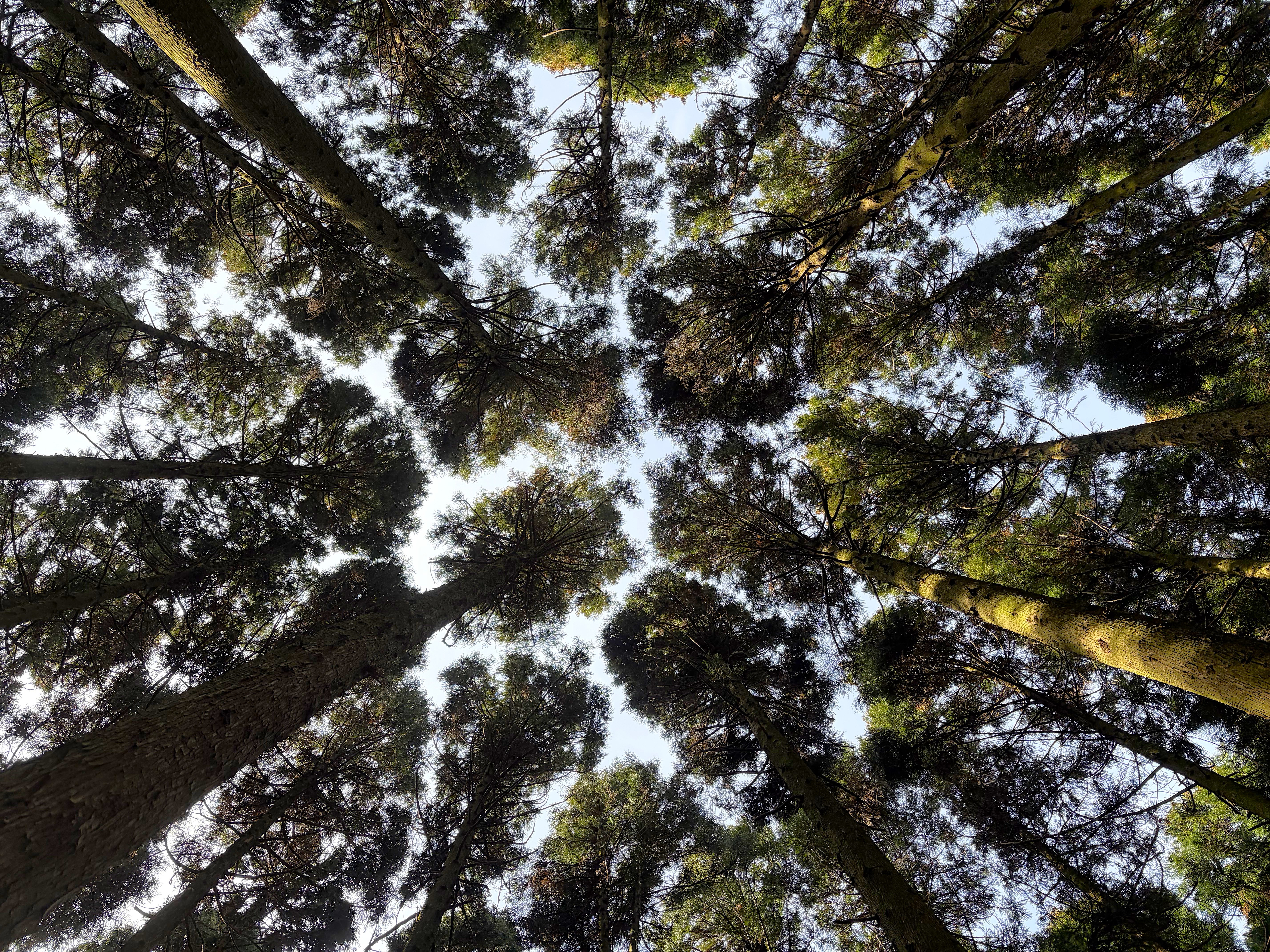
In a Prayer for the Crown-Shy, Mosscap and Dex walk through a forest. Here they observe the titular phenomenon of crown-shyness where the canopies of trees do not touch with each, creating beautiful rivers of blue-sky that flow between the borders of each tree. As Dex writes,
Dex, A Prayer for the Crown-Shy
[E]very tree was lush and full, bursting with green life … they knew exactly where to stop growing outward so that they might give their neighbors space to thrive.
This is a beautiful metaphor outlining the core principles on which this society is built — mutualistic cooperation, rather than the social Darwinism inherent in today’s cut-throat capitalistic competition. One of the ways we see this is when Dex explains the system of currency and value used by Pangans, known as digital pebbles or “pebs”. Whenever someone consumes goods or services provided by another, they pay the provider with pebs using their pocket computer (basically a phone). However, unlike money in our world, this currency is not about bartering, but rather about benefiting the community as a whole. As Mosscap says,
Mosscap, A Prayer for the Crown-Shy
The farmer feeds the musician, who brings music to the village. The technician who took a break to enjoy the music now has the energy to go fix the communications tower. The communications tower enables the meteorologist to deliver the weather report, which helps the farmer grow more apples.
All exchange brings mutual benefit to the community. People effectively give gifts to each other as there are no consequences for having a negative balance of pebs, unlike in our world where starvation and homeless ensue for the moneyless. Everyone’s balance is public and when someone’s balance has a huge negative, their friends will check in them, to see if they need any help. Everyone contributes what they can to society, according to their natural gifts and abilities, and takes what they need to survive and thrive. No one is stigmatised and shamed and left to rot on the streets with strangers walking coldly by, because they cannot contribute as much, because they need more help and more resources.
Thus, a system of reciprocity and mutual obligations is established. As highlighted by Mosscap, gifts that are received, are expected to be circulated, passed around but they are never sold for a profit. The goods being exchanged, whether an apple or the experience of beautiful music, turn into common wealth, common property for all to enjoy. In contrast, a payment would cancel out all debt, establishing parity and removing the need for further obligations. Here however, the delicate web of relationships and obligations at the heart of society is placed at the centre.
This lies in stark contrast to Thatcher’s capitalist conception of society as individuals and families. People are asked to be economically independent and pull themselves up by their bootstraps. Dependence on government welfare seen as shameful. Even the mentally disabled are asked to be economically independent. The focus is on integrating them into the workforce, which is assumed to give them dignity — as if working at (often lower than) minimum wage rates at McDonalds is really all that dignified. On the other side of the spectrum of wealth, billionaires like Elon Musk, pride themselves on having to rely on their own hard work and intelligence to achieve success, projecting a story of an individual fighting against the odds to build up a company.
Yet, upon deeper inspection, this notion falls apart. No one is ever truly independent, full reliant on only themselves. Even in our market economy, we rely on our families and friends for emotional support and a social life, on society at large for lighting at night, roads to drive on. The model of the self-made billionaire is just a smokescreen to mask the inequalities and exploitation inherent in their wealth, and neglects the contribution of all of society. So why are we so fearful to recognise and embrace this interdependence? As social creatures, none of us can go at it alone. Requiring the weakest and most vulnerable to work long hours in minimum-wage jobs for the sake of “economic-independence” not only fails to provide a dignified existence, but harmful for their socio-emotional wellbeing. Why don’t we recognise that only through cooperation like the trees, only by taking care of one another, can we all thrive together?
From this philosophy of mutual aid, arises a respect of each other’s and the natural world’s boundaries, just like how the trees limit their growth so their canopies do not touch. In Psalm and Prayer, Mother Nature is not seen as a something to be tamed, its resources harnessed by humans. Instead, humans live in harmony with nature. Dex explains that when people killed all the wild dogs in Bluebank to keep themselves safe when hiking or fishing, the elk destroyed the ecosystem by overgrazing vegetation, leading to loss of ground cover, soil erosion, etc. This parallels the eradication of wolves within Yellowstone National Park, which had similar adverse impacts on the ecosystem. However, from the perspective of the elks, the removal of their top predator was hugely beneficial, allowing their population to grow tremendously. In much the same way, humans to some extent, are not to blame for the modification and exploitation of our natural environment to make life easier and more comfortable. We are, in some sense, simply following our natural instincts. Hence, while any participant in an ecosystem desires the elimination of immediate constraints in their environment, if everyone achieves this, the ecosystem will collapse. Humans have to overcome this instinct and consciously act with restraint.
We see this in the Pangeans’ careful extraction of resources from the environment, ensuring that fish that will be eaten have already had the chance to lay eggs. They take special care to ensure that buildings are constructed with biodegradable materials such as casein and mycelium, which will be absorbed back into the natural environment once the building is abandoned.
This parallels indigenous traditions of caring for their environment, where the humans and nature are not treated as separate entities, but are understood to be intertwined. Plants and animals, rocks and mountains, are just as alive and worthy of respect as any human. In the Potawatomi language, where nouns and verbs are divided into animate and inanimate, such “objects” are referred to in the same way as family — because they are our family (Kimmerer, 2020), we are their younger siblings. As Kimmerer, a member of the Citizen Potawatomi Nation, writes
Robin Wall Kimmerer, Braiding Sweetgrass
In Potawatomi, rocks are animate, as are mountains and water and fire and places. Beings that are imbued with spirit, our sacred medicines, our songs, drums, and even stories, are all animate. The list of the inanimate [is] smaller, filled with objects that are made by people.
The world, to the Potawatomi, is a “neighbourhood of non-human residents” and a “communion of subjects”. Pecan berries, strawberries, sweetgrass. These are all gifts from Mother Nature to us, to be received with gratitude and respect, in a spirit of reciprocity. When the Earth is sacred, when plants, animals, rivers and mountains are our family, we do not release planet-destroying gases into the air, or release toxic metals into the water. We do not destroy these ecosystems to extract natural resources for profit, just as we would not kill a family member to sell their organs.
Instead, we take only what we need, giving the ecosystem the space to continue thriving. And we savour the produce of the land as a priceless gift, not to be sold for a profit but only to be given away again. All exchange brings mutual benefit to the community.
A Critique of Religion
The religion practiced by Sibling Dex is quite unlike anything we see on our planet and offers a poignant critique of today’s mainstream religions.
The most glaring difference is that unlike the puritanical Christian monks who take vows of celibacy, engaging in casual sex is part and parcel of Dex’s job, as a devotee of the God of Small Comforts. In fact, mainstream Christianity, expressly forbids the type of casual hook-ups that Dex engages in, even for regular believers. Instead, it teachers a perverted form of sexuality, where God only approves of sex between married, monogamous and heterosexual couples. It asks believers to repress their natural sexual desires, to repress “unnatural” sexual orientations like Dex’s, which do not align with their biblical worldview. Women are asked to cover up to protect their innocence, men are taught they are lustful monsters that need to be controlled. Sex is sacred, yet must be jealously guarded and hoarded. Any kind of sexual activity before marriage highly stigmatised and viewed as sinful. Even hugging or kissing someone of the opposite gender is unacceptable.
As such, people become unable to express their sexuality honestly and authentically. Just as labouring according to the purposes another is alienating, robbing labour of creativity and pleasure, the limits placed on sexual expression alienate Christians from their sexuality, making it harder for them to form healthy sexual relationships later in life.
The harm caused by this repression is not limited to simply having less fun on the bed. The suppression of sexual desire in Catholic clergy, due to their mandatory vows of celibacy, is known to be a risk factor for child sexual abuse (Royal Commission into Instituitional Responses to Child Sexual Abuse, 2017). When sexual desire is repressed, it can often lead to psychosexual dysfunction, increasing the chances that such desires flare up unexpectedly and manifest themselves in harmful ways. Furthermore, due to the knowledge that celibacy is an unattainable ideal, other clergy to whom such heinous acts have been confessed, are more likely to overlook these “minor” infractions. As a result, perpetrators get away scot-free while the victims are saddled with unimaginable trauma.
The religion practiced in Psalm and Prayer however, is radically different. The Gods do not give commands to humans, asking us to follow their perfect plan, their divinely ordained will, that we mere mortals can never comprehend. No one prays to the Gods in hopes of getting blessings. No one follows their rules and commands in for fear of eternally burning in hell. Adherents are encouraged to feel comfortable in their own skin, to simply be. We see this in how the monks embrace their gender identity without stigmatisation, being called Brother, Sister or Sibling. Dex’s sexual arousal is unabashedly depicted at multiple points in the book, through passing attraction to others and causal hookups. Consensual polyamorous relationships are normalised, as we see from Dex’s parents. This ambient queerness sits in the background, with the intention of being overlooked — which is what makes it stand out so much more at a time when the hard-fought rights of queer people are being rolled back across the globe.
As such, rather than prescribing a rigid set of often arbitrary rules, it acts more as a guide on being a good person and living a fulfilling life. As Dex says,
Dex, A Psalm for the Wild-Built
[T]he Child Gods aren’t actively involved in our lives. They’re … not like that. They can’t break the Parent Gods’ laws. They provide inspiration, not intervention. If we want change, or good fortune, or solace, we have to create it for ourselves.
This difference also appears in how the Gods view human worship. The Christian God is known as a jealous God, desiring that humans worship Him and Him alone. Belief is rewarded with eternal life. Disbelief, no matter the reason, is punished with eternity damnation. Christians are told to spread the faith and the good news, to convert the masses and save their souls — which has left a trail of cultural destruction across the world. On the other hand, the Gods of Psalm and Prayer simply do not care! As Dex says,
Dex, A Prayer for the Crown-Shy
The shrine’s not for Bosh. It’s for us. People, I mean. Bosh exists and does their work regardless of whether we pay attention. But if we do pay attention, we can connect to them. And when we do, we feel … well, you know. Whole.
Another interesting aspect of this religion, is that instead of being entrenched in the power structures of their society, it serves to liberate and guide adherents to live a fulfilling lives. In stark constrast, mainstream religions, especially Christianity, often become tools used by the oppressor class to control the oppressed. Their holy scriptures and theology are perverted and twisted to defend the domination of Capital 2. As Marx said in his famous and misunderstood quote,
Karl Marx, Critique of Hegel's Philosophy of Right
Religious suffering is, at one and the same time, the expression of real suffering and a protest against real suffering. Religion is the sigh of the oppressed creature, the heart of a heartless world, and the soul of soulless conditions. It is the opium of the people.
The abolition of religion as the illusory happiness of the people is the demand for their real happiness. To call on them to give up their illusions about their condition is to call on them to give up a condition that requires illusions. The criticism of religion is, therefore, in embryo, the criticism of that vale of tears of which religion is the halo.
Just as opium is used as a drug to relieve pain, religion relieves the pain and suffering experienced by the working classes, who work toil in the fields and in the factories, but remain unable to escape poverty. While they may not be able to earn earthly riches, they are promised an abundant existence in heaven after they pass on. They are told that poverty is pious, that their saviour is just like them, born in a manager, born not into great wealth but into poverty. Yet, such happiness gained through religion is illusory, a mere hallucination. Ultimately, the believers are still poor, still working long hours, still working in dangerous conditions — nothing has ultimately changed.
Hence, just like opium, such a belief sedates, quelling the desire for social change. Slaves are told to obey their masters. The oppressed take comfort in the promise of a heavenly reward, turning the other cheek when faced with the violence of oppression. Religion as a cultural identity has also been weaponised, convincing many to support causes that are against their own interests. Jesus exhorts the wealthy not to store up treasures on Earth, where moth and vermin destroy, but to store up treaures in heaven, to give up their wealth to support the poor and needy. Yet, in the conservative Christianity of today, billionaires such as Elon Musk and Donald Trump are lionised as saviours of the nation. Despite Jesus’ call to care for the least of these, programmes such as Medicare for All remain unpopular amongst Republicans, who are predominantly working-class. The culture war between secular and religious Americans masks the hidden class war — which has been raging in the shadows ever since Franklin D. Roosevelt dared to take on the titans of industry. Even for those who do not fall prey to the manipulations of mainstream conservative Christianity, anything beyond the status-quo remains unthinkable due to the dogma of inherently sinful humans.
The religion in Psalm and Prayer could not be more different. As previously mentioned, it emphasises that comfort and rest need not be earned. It is sufficient to just be. Protestant Christianity 3, on the other hand, is where we got the idea of needing to do work, especially unpleasant work we did not enjoy, to earn rest and comforts. As Graber writes,
David Graeber, Bullshit Jobs: A Theory
While in practical terms Puritans and other pious reformers could no longer promise much to the poor—certainly not adulthood as it used to be conceived, as freedom from the need to work under the orders of others—they substituted charity, discipline, and a renewed infusion of theology. Work, they taught, was both punishment and redemption. Work was self-mortification and as such had value in itself, even beyond the wealth it produced, which was merely a sign of God’s favor (and not to be enjoyed too much.)
This runs counter to the pre-Christian conception of work by Aristotle, who did not believe work made anyone a better person because it takes time away from social and political obligations. Leisure in contrast, is noble and necessary for philosophical, artistic and civic pursuits.
More importantly, the religion in Psalm and Prayer is explicitly anti-hierarchical. There are no centralised power structures. There are numerous sects with different interpretations of the holy scriptures that exist in harmony, unlike the tension that exists between Protestants and Catholics or Shias and Sunnis. There is no Pope, no central leader, to excommunicate and execute heretics who fail to stay in line. Furthermore, the monks are not priests or pastors, who aim to press believers to comply with their sect’s doctrines and rules, occasionally brandishing the threat of the flames of eternal damnation. Instead, the monks constantly emphasise that there is no shame or guilt in being tired, no stigma attached to anyone no matter the colour of their skin or their sexuality. As Dex says,
Dex, A Prayer for the Crown-Shy
That’s the heart of my faith, Mosscap. That is what I am saying to everyone who comes to my table. I say it out loud, all the fucking time. You don’t have to have a reason to be tired. You don’t have to earn rest or comfort. You’re allowed to just be. I say that wherever I go.
These anti-hierarchal values extend to the natural environment. Utopian as it may be, the world of Psalm and Prayer, is no Garden of Eden, with humans created in the image of God, commanded to rule and dominate all of creation. Nature is not seen as a stock of natural resources and raw material, for humans to parasitically exploit. The religion in this regard, brings to mind the animistic religions of indigenous peoples. After all, the Child Gods, Chal, Samafar and Allalae, are represented with animal avatars (specifically as a sugar bee, a sunjay and a summer bear).
In animistic religions, the Earth is seen as a living organism and a bountiful provider of food and water. As previously explained, humans are part of this living web, not separate and above it. Through viewing the Earth as a precious gift, these beliefs act as a cultural constraint, preventing humans from over-extracting resources.
Such beliefs were however, swept away in early states, which relied on hierarchal religions to legitimise the authority of the rulers. Religions became increasingly centralised at temples and religious authority handed to a priestly class. While animistic beliefs encourage people to act with restraint, taking only what they need, the hierarchal religions of states split humans from our connection to nature, giving us dominion to rule over all of creation. As Bookchin writes (Bookchin, 2006),
Murray Bookchin, Social Ecology and Communalism
With the rise of hierarchy and domination, … the seeds were planted for the belief that first nature not only exists as a world that is increasingly distinguishable from the community but one that is hierarchically organised and can be dominated by human beings. … [T]he idea of dominating nature has its primary source in the domination of human by human and in the structuring of the natural world into a hierarchical chain of being.
We see this more clearly in the creation story of the Potawatomi (Kimmerer, 2020b). It begins with Skywoman falling from Skyworld onto the Earth and being caught by geese. Trapped in an unfamiliar world, the animals help her and understand her needs. Eventually dirt is scattered on the turtle’s back, growing into Turtle Island, known to us as North America. Skywoman then scatters seeds from a bundle she is holding, tending to them and creating a beautiful garden, enjoyed by all in abundance. Only made possible by the gifts of the animals. The lesson is clear.
The story of Christianity, however, is that of a man and woman commanded to reign over all of creation. When expelled from paradise, for eating the natural produce of the Earth, they are cursed to eat only through painful toil, through the sweat of their brow.
Two creation stories and two contrasting worldviews. They have shaped cultures and the way they interact with the natural world. Needless to say, the latter provided the philosophical justification for today’s reckless exploitation of natural resources, setting in motion Earth’s sixth mass extinction. Meanwhile, the former has been swept away. It is dismissed as folklore, a piece of trivia, an artifact from a bygone era of superstitious hunter-gatherers trying to understand the world. But this neglects the crucial lesson that has guided indigenous groups for generations. That our land and the bountiful harvest is a gift from the Earth, that the plants and animals are family and, that like Skywoman, we should plant trees whose shade we might never see. Can we re-learn these lessons before its too late?
Dare to Dream
The short story, The Ones Who Walk Way from Omelas posits a magnificent utopia, describing a festival of summer in the city of Omelas, with the ringing of boats in the harbour and a horse race amongst the youth. We are told there are no kings, no slaves, no stock exchange, no secret police. The people of Omelas are happy and lack nothing. Everything is so perfect that it seems almost unbelievable. As the narrator points out,
Ursula K Le Guin, The Ones Who Walk Away from Omelas
The trouble is that we have a bad habit, encouraged by pedants and sophisticates, of considering happiness as something rather stupid. Only pain is intellectual, only evil interesting. … We have almost lost hold; we can no longer describe happy man, nor make any celebration of joy.
However, the moment the narrator explains Omelas’ singular flaw, a singular atrocity, it becomes easier to accept this world. There is a single, unfortunate child, kept in the basement of some building, where he or she wallows in filth and darkness, subsisting on only “a half-bowl of corn meal and grease a day”. The prosperity, beauty and delight of Omelas is solely dependent on the oppression and suffering of this child. Not even one kind word may be said to him or her.
When the citizens of Omelas become old enough to learn about this, they are left in shock and in disgust, outraged at this atrocity no matter how many times the tradeoff is explained. However, many soon begin to rationalise — saying that the child would not make much of its freedom should it be released or that it would not make sense to throw away the happiness of thousands for the chance of happiness for one.
This is a clear allegory for capitalism, where the wealth and prosperity of the developed world, are built-off the exploitation of the developing world. The cobalt in the device you read this on was likely mined by children as young as 6 in the Congo. The cheap clothes you are wearing were likely woven by women working in sweatshops in China. And yet, we don’t think about these, or rationalise them away, believing that, in due time, the rising tide will lift their boats too. Believing that there will always be rich and poor countries, and rich and poor people — we should simply accept our lot in life, stop asking questions and work hard to climb up the socioeconomic ladder — hence providing the moral justification for us to continue to consume with impunity. We cannot even imagine an alternative to this system, just as we cannot bring ourselves to believe in Omelas, because we have been conditioned to believe no society can be perfect and utopian, because we have been conditioned to believe us humans are far too flawed and imperfect to build such a world. But are we?
The narrator tells us of one more thing. There are some citizens of Omelas, who upon learning about the suffering child and do not go home to weep or rage, but rather walk straight out of the gates of Omelas.
Ursula K Le Guin, The Ones Who Walk Away from Omelas
The place they go towards is a place even less imaginable to most of us than the city of happiness. I cannot describe it at all. It is possible it does not exist. But they seem to know where they are going, the ones who walk away from Omelas.
The ones who walk away from Omelas do so, as they can imagine a better option and choose to reject this false dichotomy. This is precisely the purpose and goal of Psalm and Prayer — to demonstrate what this perfect society could look like. The books pull back the curtain over the “natural order” of our world, showing it is in fact, so deeply unnatural. As Le Guin says,
Ursula K Le Guin
We live in capitalism, its power seems inescapable — but then, so did the divine right of kings. Any human power can be resisted and changed by human beings. Resistance and change often begin in art. Very often in our art, the art of words.
Hence, do not be deceived when you are told that this is not “realistic”, that our economic system is in any way “natural”. The cold, calculating logic of the market and private property demands that commonly-held land, the most common arrangement through out human history, is divided up and enclosed. Prices are assigned to everything, everything can be bought and sold as commodity, even human lives. It is the desire to govern every facet of life with according to this logic, that is so deeply unnatural.
This disease is never more alive, never more powerful, than when we sleep, when we implicitly accept that the status quo is too difficult, even impossible to change. Instead, we must realise that a better world is possible and begin the work of building it today, whether that means demanding it from our politicians or doing it ourselves. We could build a world centred on comfort, where people no longer slave away for meagre pay, and all are free to partake and share in life’s glories. It would be one where we are not coerced to labour by hunger and homelessness, but one where we choose our vocation freely. It will consist not of atomised, isolated individuals, but of a society built off cooperation and interdependency. Religion no longer will be a tool for subjugation but will liberate and serve as a source of human dignity and compassion. We will see our land once again as a gift, and show restraint in how we use it.
But, do not delude yourself that this struggle will be easy, that with a single blow, the oppressors will voluntarily hand over power. This world is so radical that it can only come little by little, as authoritarian, oppressive structures are slowly but surely dismantled and replaced with horizontal, democractic ones. The elites and oligarchs will certainly struggle against this, for their power will be shattered, for they do not realise that in dehumanising and exploiting others, they deny their own humanity. Thus, this struggle for a truly free world, is not one that can be won in a matter of days, months, years or even centuries. Such a project will never be truly completed. History will never end, unlike Francis Fukuyama’s prediction, nor should we let it. We must never stop dreaming, never allow our imagination to be constrained — and always keep fighting, for our neighbours, for our community and for a better world.
Footnotes
-
This is not to say they don’t need to. But in many cases, if students (and their parents!) accept that perfect grades are an unreasonable expectation, they may not need to. The notion that perfect grades are mandatory is of course, a result of capitalism. No one wants to end up as a low-wage factory worker or worse, homeless.
-
Sometimes they don’t even need to be twisted, with sections of the Bible explicitly condoning and defending the institution of slavery.
-
This is not to say that Christianity cannot be interpreted to emphasise the need for comfort and rest. It can be argued that God created the Sabbath to remind us to rest and take a break from endless work, just as he needed to rest on the 7th day of creation.
References
- Kimmerer, R. W. (2020a). Braiding Sweetgrass: Indigenous Wisdom, Scientific Knowledge and the Teachings of Plants (pp. 55–56). Penguin Books.
- Kimmerer, R. W. (2020b). Braiding Sweetgrass: Indigenous Wisdom, Scientific Knowledge and the Teachings of Plants (pp. 3–4). Penguin Books.
- Royal Commission into Instituitional Responses to Child Sexual Abuse. (2017). Religious Instituitions - Book 1 (pp. 46–47). Royal Commission into Instituitional Responses to Child Sexual Abuse.